When Anti-Whiteness Becomes Anti-Brownness

Probably one of the most enlightening and challenging chapters of Ibram X Kendi’s book “How to be an AntiRacist” is the chapter named “White”. It delves into how dismantling racism as a system demands each of us to consider how whiteness operates within all of us. It highlights how becoming hyperfocused on white people misses the mark on dismantling the system. It includes the powerful line:

In the end, anti-White racist ideas, in taking some or all of the focus off racist power, become anti-Black. In the end, hating White people becomes hating Black people.

It kind of turned my brain inside out, but led to a valuable wānanga about what it is to be Māori kiritea (light skinned Māori) and how to wield my own kiritea-tanga (light-skinned-ness) responsibly.

There are some crucial anti-racist learnings that we need to undertake as a people in order to step into tino rangatiratanga with our fullest potential, and not as vessels of white supremacist ideas. Understanding how whiteness operates as a system is crucial to that.

Now before I go further, a few 101s to set the scene:

As most of us should know, racism is not a uniform experience, and because of this, everyone’s anti-racism journey is different. The things I have to learn and un-learn, and the journey I need to take as a CIS gendered, light-skinned Ngāti Porou wāhine mau-moko, is not the same journey as a queer non-binary dark-skinned Māori, which is different again for people of other ethnicities and qualities. With that said, there are some known common-truths in the field of anti-Racism. These are not mere opinions, but established truths that result from years of expertise, research, activism and careful consideration within a community of peers dedicated to anti-racism.

One such truth is that the dominant form of racism that has come to shape the world is white European supremacy. That is the racism which has travelled the furthest, has the greatest influence on power at all levels from international through to local levels. When you speak, dress, pray, and visually present in ways that align with being a white European, you clash less with the dominant system. This means that white people have a lot to unlearn, including subtle and not-so-subtle ideas about their own supremacy. The anti-racism journey is specific for white Europeans who receive the most privilege and comfort in the dominant system, and for whom engaging with racism is entirely optional. Our journeys are different.

Terms like white-passing have more recently been utilised to describe the relative privilege experienced by those within a racialised minority who have light skin. It is utilised to describe an ability to “code-switch” and evade prejudice – an ability which is available to lighter skinned members of BIPOC communities, but unavailable to darker skinned members.

Things get a bit tricky, though, when you are applying a term that derives out of a specific racialised history from one group (Black American slave history) and try to apply it to Māori. It can become too easy to forget the history and deeper meanings behind the term. It can also be a clumsy fit with the cultural context it’s being injected into – and so for Te Ao Māori, rather than invoking a history that is not altogether ours to invoke, we can perhaps rely on terms such as white-presenting, or Māori kiritea (light skinned) which has grown into its own to describe the specific experience of being light-skinned, but having whakapapa Māori.

In both cases, though – there are two truths at play:

  1. It is true that merely having light skin does not exempt you from the racism directed at your people. It can make racists more relaxed to say offensive things in your presence, and you are also more likely to experience positive racism (racist comments like “you speak so eloquently for a Māori” or being cast as a “pretty” for having light features), or having your cultural reality ignored, both by people outside of your community, and within it. It’s also true that many of the intergenerational health, economic and education outcomes of racism still land on light-skinned mokopuna.
  2. In saying all of that, it is also true that having light skin means you will be less oppressed in the justice system, will not be followed through stores, will have less barriers to employment, will be treated differently in education settings, and social settings – in short, the world will treat you very differently.

Jesse Williams speaks about how he manages these two truths in the following clip, and I think there are takeaways from what he is saying that is also true for the context of being kiritea:

As he acknowledged, it’s important to approach the issue with a level of sensitivity for kiritea, but in saying that – over the years of observing conversations about colourism in Te Ao Māori, they have arisen because kiritea have not behaved in way that takes their relative whiteness into account. While some might verbally acknowledge their whiteness (and in this context I mean the lightness of their skin rather than a set of behaviours) and the privilege it brings, this is usually forgotten within a few sentences, and they are back to claiming rights and entitlements as if their whiteness is negated by their whakapapa Māori.

So let me say this clearly: Whiteness is not negated by whakapapa Māori – and whakapapa Māori is not negated by whiteness.

Let’s break that down a bit more:

Whakapapa Māori Is Not Negated By Whiteness
Your whakapapa is not reflected by the colour of your skin. My mother may be a light-skinned Māori, a child of two other light-skinned Māori. My father may be dark-skinned, from Papua New Guinea. I may have my father’s skin but that is no reflection of my whakapapa Māori. Whakapapa is its own validation system and it needs no qualifying – if your mother is Māori, you are Māori – end of discussion. Whakapapa is not based upon blood quantum. Within the context of whakapapa, we are more than the sum of our parts, we are more than walking pie-charts, we are whole and complete as Māori, while carrying non-Māori bloodlines.

Whiteness Is Not Negated By Whakapapa Māori
Probably this government more than any other (specifically Peters, Seymour, Chhour, Jones, McKee, and Potaka) has helped us to see how Māori can uphold white supremacy. Yet still, it’s a challenge for the rest of us to see how whiteness might work through us. While it’s true that your whakapapa is sacrosanct and cannot be challenged by the colour of your skin, it’s also true that the world will treat you differently regardless of your whakapapa. When a security person spots you from 50meters away, and decides whether or not to follow you through the store, they won’t know that you have whakapapa Māori. When you drive past a police car and they make a call whether to pull you up, they don’t know your whakapapa. The world around you makes decisions every day that are influenced by the dominant system of racism, and the colour of your skin. Te Ao Māori is also not exempt from anti-Blackness – from those who deny that colourism exists to implicit and explicit suggestions about beauty, strength, or appropriate roles for people according to skin-colour. Whiteness as a system exists, and can operate through you, regardless of your whakapapa.

That is not to say that, as Māori kiritea, your existence makes you a part of the problem – however, if your revulsion to whiteness leads to you denying that it operates through you, then THAT is a problem. If it leads to you pushing yourself and your angst to the foreground, demanding that others overlook your whiteness, and talking over darker skinned people about anti-Blackness – then yes, you are a part of the problem. Ironically, these are all recognisable as the argumentative tools of whiteness – evasion, fragility, denialism, centering oneself, individualising the issue. At that point, your whiteness has shifted from being the colour of your skin to being a set of behaviours informed by whiteness. At that point, it becomes harmful towards darker skinned folks in your own community. At that point, anti-whiteness becomes anti-brownness, towards others.

There is another sad paradox at play here, where Māori kiritea are so hyper-sensitive; so swift, and so intent to distance themselves from their whiteness that it confirms the very issue they are arguing against – that whiteness has anything at all to do with their whakapapa, and identity. Being secure in your whakapapa should not result in feeling the need to defend it – in fact your secure identity should allow you to engage in discussions about whiteness. It should allow you to sit with discomfort, allow others to speak to their experiences of colourism, acknowledge the privilege you receive and cede space and power accordingly, without ever feeling “less Māori”. Honouring yourself as a complete Māori means embracing your entire whakapapa (both Māori and non-Māori). You cannot do this if you are anti-White. Treating your whakapapa pākehā as if it is a threat to your whakapapa Māori disrespects both your whakapapa pākehā AND your whakapapa Māori. At that point, anti-whiteness becomes anti-brownness, towards yourself.

These are the gnarly questions we must contend with as we move closer to self-determination and Tiriti justice. These questions will require courage, discipline, and confidence, balanced with humility. Like all journeys of consequence, it will necessarily include discomfort – but if we truly believe in our rangatiratanga potential, then it should be a journey we are all willing to undertake.

It Takes a Kāinga

Screenshot from It Takes a Kāinga, new documentary directed by Taylor Hohepa

“Count yourself lucky, some can’t stop having babies”
“Some people just aren’t meant to give birth”
“The public health system isn’t here to help your kind reproduce, you know”

All of these things are from the mouths of health care workers in Aotearoa – I know, because they were said to me. No doubt a lot of folks would be surprised that I would “let” someone talk to me like that, and these days I wouldn’t, but when you’re young, and feel alone, feeling confused, vulnerable, powerless and embarrassed – when don’t have the tools to process what you’re hearing, and don’t feel like you’d be heard anyway, the safest, simplest thing to do is just shut down, go home and try to make it through to the end of that day.

Over the years that I tried and failed to have children, I thought so many times about whether I could have or should have done something different, maybe I was wrong, maybe I was cursed, maybe I didn’t deserve to be a Māmā, maybe I could have tried harder, maybe maybe maybe…

Then I started working in Māori health research and learnt about the systemic racism in our health sector, how it layered on top of systemic sexism and made wāhine and irawhiti Māori, especially when hapū, primary targets for very harmful treatment in the system. When I accepted a job offer to work with young wāhine navigating our maternal health system, I was determined to prevent others experiencing what I had. The young wāhine I had the honour to work with (some of whom I am still in touch with today) were so inspirational. Resourceful. Committed. Some scared. All incredible.

When I started working on that project, in 2010, suicide was the leading cause of death for young Māori Māmā under 20, and had been for at least three years (I hadn’t looked before that point). 15 years later, under both Labour and National governments, it is still the same. Over both of these governments, in my discussions with young Māmā and irawhiti (both through that study and in others), the systemic problems have existed – GPs who, upon confirmation of pregnancy simply hand the wāhine a list of midwives and a handful of leaflets, assuming they have the phone, or credit, or language necessary to navigate those calls. Midwives who are terrified of being blamed for all of the “problems” that occur with young Māori and Pasifica births. Young wāhine who call name after name on that list and are told repeatedly that the “books are full, sorry”… and so they wind up with the hospital maternity care team, who is different each time and so they have to tell their story again, and again. Parenting classes that are full of middle-class pākeha women who definitely don’t have to worry about busfares and absolutely make all their midwife appointments and undoubtedly know where they’re going to be living and raising their child next year.. and all have a particular side-glance that makes the word “slut” almost audible, even when they’re smiling. Māori midwives that are overwhelmed with clients that others won’t take on. Media and politicians that basically say the same thing, but in more words. A health system that rarely takes the broader whānau into consideration, and almost never considers the needs of the young father, or how to support their relationship. Teen Parent Units that simply don’t have room for the amount of young Māmās, and so education is cut short, affecting employ-ability, housing, health, and stability for both the parents and baby. An unforgiving mainstream school system that has no space for her when she can’t make it into the Teen Parent Unit (but was also the same education system that failed to provide adequate reproductive health education in the first place, because it was busy arguing with the health system about whose responsibility it was). A degrading, clunky benefit system that demands to know everything about her young relationship, and penalises her for telling the truth, but incarcerates her for telling a lie. The ever present threat (even in the maternity ward) of the state appearing, like a suited boogieman, to take her child from her arms, and all of this in a world that expects her to instantly, magically, exhibit the traits and decision making abilities of a fully grown adult, severely judging her for being anything other than that – and, well if we’re being completely honest, judges her anyway.

I would challenge anyone to balance all of that and not be in severe distress.

Screenshot from It Takes a Kāinga

It’s a kaupapa that has remained close to my heart over the years, and what I have learnt since developing my research on the Doctrine of Discovery over the past decade, is that it is an experience that is of design, which is to say, it is a health system that was built upon assumptions of mental and physical health for European men. Worse than that, at these same foundations is science that was not only neglecting and ignoring Indigenous people, but intending harm towards Indigenous people. This harm was not intended for its own sake, but rather to retain power and privilege in the hands of European men. And worse still – all of this is taking place within a system that is built upon a premise that Indigenous people, and certainly Indigenous women, are not sacred in their own right – so naturally, this is in direct contrast to the whakapapa from whence we have come.

I’d like to say this behaviour is a historical relic, but commentary on Māori health by the current government, and their supporters, suggests it is very much still an active attitude today. Even when faced with clear evidence that racism is deeply entrenched within our health system, and that it would be not only more effective, but also more cost-effective, for Māori to design and run our own health system – the current government brandished our lives as electoral points. It condemned itself to a health model based upon Treaty injustice, and all the poor health impacts that go with it, confirming for us that Tiriti justice cannot happen in piece-meal, and is only sustainable through a whole-of-government Tiriti centered constitution. Like so many other measures (incarceration, income, housing and education), our suicide statistics are mirrored in the Indigenous peoples of so-called Australia, Canada, and the USA – across radically differing cultures, but all of which share one common denominator: colonisation. Consistently, across all of these contexts, the issue is longstanding and intergenerational – linked to trauma caused by colonisation. Consistently, across all of these contexts, Indigenous women have been targeted by a racist, sexist, ageist system. Consistently, across all of these contexts, Indigenous women and their whānau have been blamed as promiscuous, and the culture itself blamed for producing poor parents, consistently, across all of these contexts, colonial governments have used these fictions to justify taking children away and creating new cycles of harm and consistently, across all of these contexts, the colonial government has failed to really account for the role colonisation has played in the lives of Indigenous women and children, and actually do something about it.

It Takes a Kāinga, directed by Taylor Hohepa and fronted by Ria Hall, is a powerful celebration of our Māmā Māori.

So when I was approached to contribute towards the documentary “It Takes a Kāinga”, it was an easy yes. The more voices we have out there, affirming to our Māmā that they are not just right, but are incredible, exceptional testaments to Indigenous strength, reaffirming their sacredness and beauty – the more voices we have calling in their whānau to wrap around them, listen to them and believe in them, the more voices we have calling upon colonial governments to be accountable for their harm, the better. Media like this is exactly what we need right now, not just to expose colonial shittery, but to highlight Indigenous strength and beauty, and both are necessary while we still have colonisers wielding political power over our worlds. That’s not to say the coloniser should get all our energy. Wāhine and their partners have been very clear about what kind of support is missing:

  • Support that is appropriate to their age, peer group, economic circumstances and culture
  • Connections to other wāhine hapū of their peer group
  • Support from older wāhine (their mothers, aunts, and grandmothers)
  • Somewhere they can safely ask questions about sex, reproduction, their bodies, and raising babies
  • Support that is inclusive of their partner’s needs
  • Support for their whānau to be the best safety net they can be for Māmā and baby
  • Continuity of care from the moment their pregnancy is confirmed
  • Support well beyond birth, through to the first thousand days
  • Support for them to pursue their aspirations through continued education and employment

And just overall, less judgement. See them for who they are, see the best in them, and trust in their potential. I have lost count of the number of times I have heard the importance of being a “trusted” service for Māori, for rangatahi and for Māmās – but young Māori Māmā are one of the most distrusted groups out there, and they feel it, and trust is not a one-way street. Māori Māmā are exercising sound critical judgement when they don’t trust the system – there is no historical or current basis to do so, statistically they are highly likely to have their children removed – even when they do everything right – and see their children placed into abusive state facilities. I wouldn’t trust the system either, and armed with that knowledge I doubt many others would.

But if sound support is received, if Māmās get the support they need, in the way that they need it, then incredible things can happen. Supporting young Māmās to reach their potential, not just as Māmās but as wāhine, is called “circuit breaker” support, because it interrupts intergenerational cycles of harm and injustice.

Screenshot from It Takes a Kāinga

And while we should always continue to hold the system to account for its failings, and continue to call for better, more just systems, there are things we can do right now to look after our young Māmā better. Organisations that work with our young Māmā and their whānau – you can ensure that every single staff member (both frontline and admin) is aware of the colonial context, specific to the worlds of our young Māmā and their whānau, and act, and speak accordingly, you can build your own organisational policies around whānau-wide engagement and respecting the tapu of wāhine and tamariki. Parents, you can seek out ways to have appropriate discussions with your children about sex, reproduction, and whakapapa, you needn’t leave that up to schools – children who feel comfortable to have conversations with their parents about their bodies and relationships are far more likely to make empowered decisions, and far more likely to reach out for help when it’s needed. As a whānau, you can wānanga together and develop your own tikanga-a-whānau about how you will wrap around Māmā they are hapū. There are incredible resources out there, look into the research on Māori birthing, wāhine and parenting by Kuni Jenkins, Leonie Pihama, Naomi Simmonds, Ngāhuia Murphy and others – follow groups like Tupuna Parenting on Facebook. This system was never made to look after our wāhine or our babies, but we can wrap around them ourselves.

Indigenous Sacredness, Christendom and the Doctrine of Discovery.

One of the most contentious aspects of delivering Doctrine of Discovery workshops is the challenge to people’s faith systems. In a good number of the sessions, someone will raise the issue at the end, declaring themselves a person of faith, and asking for guidance in how to reconcile the role of the faith, which guides them through this world, with the central role of Christianity in the enduring violence of colonisation.

Now I, personally, am not a Christian. I’m not a scholar of the scriptures, I cannot point to any particular biblical passage to salve them – nor do I believe that’s my responsibility or purpose. I deliver workshops on historical and enduring systems of colonial racism, I point to solutions that have been effective in addressing the impacts of colonialism, but I cannot help people reconcile the facts with their choices of faith, today. While I can’t take that journey for them, I encourage them to seek solutions from within their faith community, and share with them that I have met a number of faith leaders overseas who dedicate significant time, energy, and resource to reckoning with, and responding to, the role of the church in colonisation. The rest is their journey to take, I cannot take it as a non-Christian.

That is not to say I am anti-Christian, or call for the removal of Christianity. When I consider what justice might look like for Aotearoa in the face of colonisation, whether it be an imagining of what we would be like were we not colonised by Britain, or what a Tiriti-centered nation would look like – both of those scenarios allow for the presence of all faith systems, and the freedom of Māori to engage with the faith system of their choice. So the right of Māori to access and adopt Christianity as a faith system is supported in both an anti-colonial and a Tiriti-centered perspective.

The conversation I am much more interested in, and that I feel is important to have – is an open, and frank conversation about the role Christianity has played, and still plays in colonisation, the impacts of that history, how it continues to draw privilege from colonialism, how it reckons with these facts, and what its place should be in an anticolonial future.

That the church has played a role in colonisation should be unquestionable. It’s not called “The Doctrine of Christian Discovery” for nothing. From the very outset, the ravenous entitlement of the European gaze upon other lands and the people of those lands was couched in ideas of divine religious supremacy. While this has extended to notions of cultural and intellectual supremacy, the idea that Christianity is a superior faith to all others has endured throughout time and influenced economies, politics and society at large .

Religious supremacy has played a significant role in the colonial process not only as a justification for colonialism, but as a tool of subjugation within the process of colonisation. The denial of Indigenous sacredness is a central and consistent feature of the Doctrine of Discovery, everywhere it has been applied. It plays a crucial role in diminishing the status of Indigenous peoples as a precursor to their dispossession and enslavement. Importantly, if Indigenous peoples can themselves be convinced that their own pre-colonial faith systems are inferior, then they can be more easily absorbed into the colonial hierarchy of God, the Church, the Monarchy and the power systems they have collectively created (including colonial governments). Colonial domination is ultimately a power project, and for our tīpuna, political and spiritual power were intertwined, managed through rangatira and tohunga. The introduction of a superior European God, together with the outlawing of tohunga and the subjugation of rangatira functioned to undermine the power structure for Māori, paving the way for colonial domination.

Everywhere the colonial project landed, the very first proclamations were of religious supremacy, directing natives to “submit to the yoke” of the Cross and the Crown. From that point on, religious supremacy was reiterated by missionaries, priests, Christians, and their converts, everywhere they went. The dominance of Christian faith was communicated through ceremonies, education, media, currency, and in every day language. Indigenous faith systems that revered ancestors, or nature, or ancestors AS nature, were generally reviled and ridiculed as pagan and primitive within the colonial project. Christian ministers, politicians and theorists distorted Indigenous deities, at times to suggest that they were demonic, at other times suggesting that Indigenous deities were actually the Christian God, in disguise. Being patriarchal, colonial anthropologists also often deliberately erased female and child deities. Recognising that women and children often held sacred roles within Indigenous communities, the deliberate targeting of them is a longstanding warfare tactic, aimed to demoralise the enemy. Labelling Ātua Māori as “lesser Gods”, false idols, or even demonic and dangerous, creates another layer of European supremacy, interacting with other suggestions of European supremacy that saturate colonial society – culminating in a pervasive message of Indigenous inferiority and dependence upon colonial systems in order to access “true”, “ultimate” sacredness.

For Māori, our Ātua are our ancestors, as well as being nature, and are at the very beginning of our whakapapa – our broad genealogy that connects us to all ancestors, to nature, and to the universe. An attack upon Ātua Māori is therefore an attack upon our whakapapa. For many of our ancestors, being told that our understanding of the universe, and our place within it is not so, that our sacred ceremonies are actually harmful, held profound psychological consequences. This psychological harm is layered upon colonial injustices such as matakite being committed to “lunatic asylums” and the criminalisation of tohunga through the 1910 Tohunga Suppression Act – even as Pentecostal and other Christian churches continued to carry out “faith healings”. Consistently throughout history, Māori spiritual practices have been treated as arcane, dangerous and esoteric, where Euro-Christian spiritual practices are normalised, to the point where they feature in the opening of parliament.

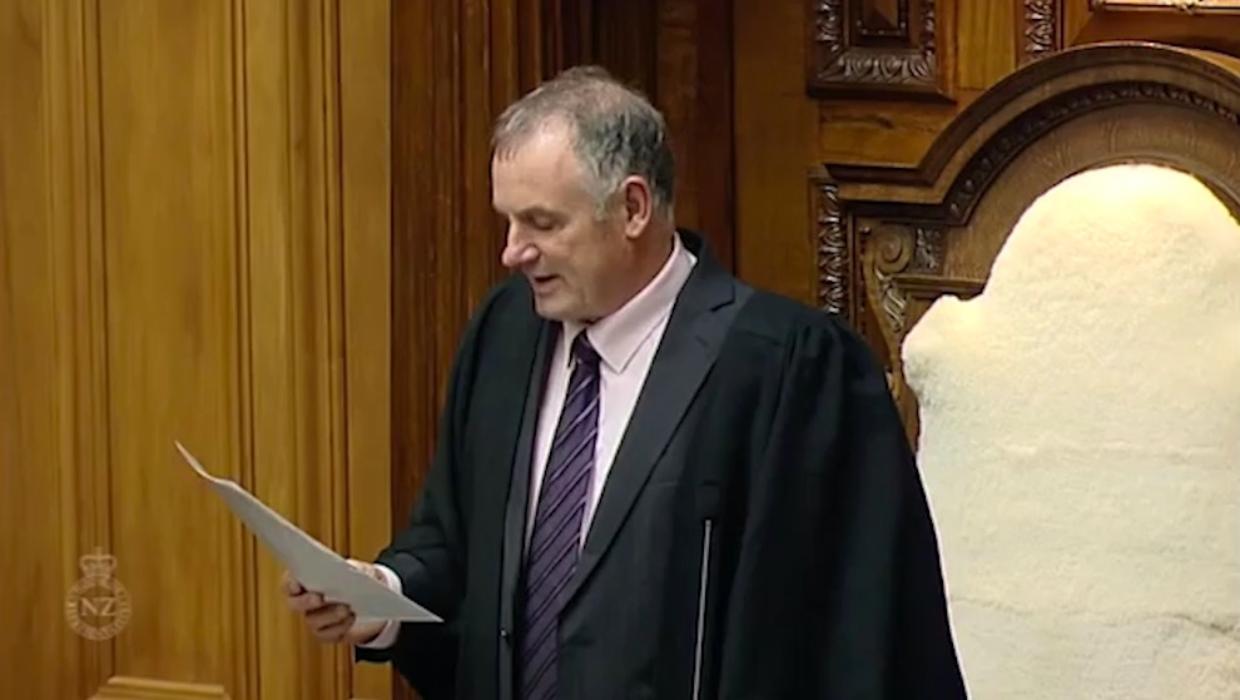
(Previous Speaker of the House Trevor Mallard reading out the parliamentary prayer at the opening of parliament)

Political protection of Christianity within colonies is rooted in the Catholic legal concept of Jus Patronus, which initially related to the patronage of the Church, but within the context of the Doctrine of Discovery, came to refer to the relationship between the Church and the Crown, where the Church would devolve it’s “divine authority” to dominate down to the Crown, and in return the Crown would protect the Church in carrying out it’s core business: converting natives.

While numerous Churches often reflect upon the benign and protective role of missionaries preceding, during and after the signing of Te Tiriti o Waitangi, it’s also the case that Churches have been responsible for significant land dispossession. It perhaps comes as no surprise that the introduction of the Doctrine of Discovery into New Zealand case law occurs through Wi Parata vs Bishop of Wellington, a case where a church refused to return land that was gifted for the express purpose of building a school for Ngati Toa children, however the school never eventuated, and the Church never gave the land back – in declaring Te Tiriti a ”mere nullity”, Justice James Prendergast cited Johnson v M’Intosh as a precedent – a United States courtcase that negated all native land rights upon the arrival of Europeans, asserting the rights and entitlements of the Doctrine of Discovery. From this point on Wi Parata vs Bishop of Wellington was used in NZ case law as a precedent to alienate significant tracts of land, and was only conclusively overturned in 2004. The Ngati Toa case is not exceptional, across Aotearoa, Christian churches received and held stolen Māori land, and many still retain that land to this day. In fact, Christian churches remain some of the country’s largest landholders: The Roman Catholic Archdiocese of Wellington listed $13.5m in investment properties in 2015, and the Catholic Diocese of Christchurch listed $11.6m in buildings, $593,000 in buildings in progress and $34.6m in land in 2016. In 2017, it was reported that the Anglican diocese in Canterbury had $320m in cash and properties. The Presbytarian Church owns $1.5bn in land assets and 400 properties. Brethren-owned Trinity Lands are big players in dairy, forestry and kiwifruit. Christian churches hold more land than Fonterra, and are active political lobbyists. Christian leaders also enjoy an exclusive audience with the Prime Minister every year. While New Zealand’s political-religious ties may not be as obvious as other nations such as the United States, they are very present, and very effective in protecting Christian privilege, acquired through the Church’s role in the colonial project. Doctrine of Discovery scholar Steve Newcombe describes the economic-political power complex of Christianity as Christendom, differentiating it from the faith itself.

(Christian leaders meet with Ex-Prime Minister Ardern. Annual meetings with the PM have been held since 1998)

An aspect of researching colonialism at a trans-national level, is that you get to see the patterns of colonialism around the world. One particular consistent feature, is that in every single instance, Christianity has forwarded a position that the Indigenous group was warlike, primitive, and doomed to self-elimination, and that Christianity came along to save us from ourselves. In many cases, what is conveniently omitted is that missionaries usually arrive on Indigenous shores a little while after muskets, and that the inception of colonialism has always initiated a period of increased conflict, made worse by the introduction of firearms. Missionaries then subsequently feature as a “voice of reason” to the warring savages, and this becomes an entrenched colonial fiction. Rarely is it ever acknowledged that, like all others, Indigenous communities had periods of conflict, had their own means for resolving said conflict (eg marriages, ceremony, law or trade), and also had longstanding periods of peace. The ability of Indigenous peoples to rationally navigate our way through conflict is erased within the colonial narrative, so that Euro-christianity can fulfil that role. Throughout the global colonial project, Euro-Christianity has claimed responsibility for stopping Africans from enslaving each other, stopping First Nations Americans from warring with each other, stopping Aboriginal people from killing their children and stopping Māori from cannibalism. In every single Indigenous instance, it is suggested that were it not for Christianity, the relative Indigenous nation would have wiped themselves and each other out, and the inference is that Indigenous people therefore owe Christianity their allegiance and faith – and if we do not, then we will somehow regress back to this warring, primitive state. Of course, Christian nations have carried out the world’s most enduring, widescale wars – many of which are still carrying on today, but for whatever reason, although the “warring nature” of Indigenous nations provides the grounds for conversion to Christianity, the enduring warring nature of Christianity provides the ground for Māori to go to war “for God, King, and Country”.

It would be one thing if this was a historical relic, but as a narrative, its still very present within Te Ao Māori. We are still told, today, that violence was due to our Ātua, and that peace was due to Christianity. We are still told, today, that Christianity is more sacred than Ātua Māori. While some Christian leaders have been open to the conversation of how we reckon with these histories, and what should be done about them today, more often than not, what I’ve seen from the church, is a brushing off of this history, using responses that are recognisably similar to denials of colonialism in general:

  • “Let’s put the imperialism part of Christianity to the side” (psst – Christianity is not aioli)
  • “Māori weren’t saints, you know” (apparently you have to be a saint to avoid being colonised)
  • “We held on to both” (no, we didn’t, not to the same degree, evidenced by the fact that its so much easier to access and learn inoi Karaitiana than karakia taketake)
  • “That’s so negative and boring, let’s focus on the positives of Christianity and why Māori embraced it” (as if that’s a novel discussion, I guess someone missed the previous centuries of discussions centred on why everyone converts, and should keep converting, to Christianity?)
  • “Oh, that Doctrine of Discovery, well it’s governments that applied that, you should talk to them about it” (and the government of course says “that’s a religious thing, you should talk to Churches about it”)

In short, the talking points surrounding the refusal of this discussion are based upon stock, standard evasive logic. I could replace Christianity with colonisation in any of those sentences and we will instantly recognise them as coloniser-speak.

There are, however, a few faith leaders I have met along my way who are interested, and enthusiastic, to have this discussion from within the framework of their faith, and that IS an interesting and heartening conversation. To me, these people seem to be the most settled in their relationship to their Christianity – they are tau enough in their relationship to their God that the discussion does not perturb them, and in fact a few see it as an opportunity to be even better Christians. The Mennonite Church commits significant funds into producing resources about the Doctrine of Discovery, here in Aotearoa the Presbytarian Church are looking to offer iwi Māori first right of refusal for all land sales (not quite landback and certainly would be improved by just GIVING it back, especially where it was gifted or confiscated to them in the first place, but it’s a step). Recently I attended a conference in Syracuse University, New York State, titled “The Religious Origins of White Supremacy” and was heartened by some of the Christians I met there – there was a Bishops panel, and they were rightfully challenged on when they will progress beyond nice words and sit down with Indigenous leaders to talk about material solutions and restitution. To be honest, I was surprised that they even showed up – I’m not sure as many would do so in Aotearoa. Other faith organisations there were even more forthright in the work they do to counter the systems of harm that Christianity established.

As we mature our discussions about the Doctrine of Discovery and its impact upon Aotearoa, we are going to have to be increasingly courageous in our discussions. I’ve often said to Tangata Tiriti that they should benchmark their discomfort with the discomfort of being colonised – in the same way, when we feel discomfort in discussing the role of the Church in colonisation, we must benchmark that with the discomfort, in fact, massive upheaval, of our tipuna who had their entire universe re-shaped by the introduction, and political re-inforcement, of Christianity. I look forward to the day when we can have these discussions openly, allow the mamae to surface and heal, work together on the solutions, and then walk together towards our anti-colonial future.

Make No Mistake – there is no Indigenous support for Israel.

The Indigenous support for Palestine around the world has been overwhelming, and Aotearoa is no exception. Week after week, Tangata Whenua have shown up in support of Palestine. This alone is a mark to the depth of feeling New Zealanders have about this matter, not just that they show up, but that they KEEP showing up, every week. In an age where wrong-doers rely on the public to get bored and move on – that hasn’t happened. Quite the opposite, actually – with every week passing, more and more Tangata Whenua are committing time and effort to understanding and opposing the genocide being carried out by Israel, first and foremost as a matter of their own humanity, but also as a matter of Indigenous solidarity. Still, as we’ve seen here in Aotearoa (and in so-called United States/Canada and Australia as well), there are always a few Indigenous outliers who are co-opted into colonial agendas, and try to paint their colonialism as being Indigenous.

In Aotearoa, those outliers have names, they are Destiny Church (and their political arm, the “Freedom and Rights Coalition”), and the “Indigenous Coalition for Israel”.

If this is as far as you want to read then here’s the takeaway:
This is not Indigenous support for Israel. It is Indigenous people, recruited into colonial support for Israel. It is easily debunked by the following facts:
– Israel is a product of western colonialism
– Both groups are centered on Euro-Christian conservatism
– Both groups are affiliated with the far-right and white supremacists
– Maori have made it very clear, on our most important political platforms, that we stand with Palestine.

When you see media profiling these groups as “Indigenous support for Israel“, it’s important to note that a hallmark of Western domination is the tendency to see Indigenous Peoples as a homogenous group. Even the smallest cohort of Indigenous peoples are, within a Western colonial mind (and to Western media), cast as representative of the whole.

Equally important to note is that Indigenous people, through the process of colonialism, are regularly co-opted into colonial agendas, and this is often platformed by media to suggest Indigenous support for colonialism. The most energy-efficient model of colonialism is Indigenous people carrying it out upon each other, and New Zealand’s colonial project has relied heavily upon a strategy of aggressive assimilation and recruitment.

So it’s important, when we see Indigenous peoples holding a particular position, that we look beyond how they name and present themselves, and interrogate who they are, what mandate they have, and what they stand for.

In spite of the co-option and assimilation, Indigenous Peoples have a long history of working collectively in the shared cause of dismantling colonialism. We are the second largest political movement in the world, numbering over 500million. Those involved in Indigenous rights know who other Indigenous groups are, we know the legitimate forums, we know our shared issues and many of each others’ distinct issues, we know our political histories and our political figures. The language of Indigenous rights is a shared language.

We also know colonial political language and tactics. So when it comes to Indigenous people who support Israel – while they, themselves may present as Indigenous, their politics are most certainly not.

It takes Indigenous critical analysis to identify this – that being a knowledge of:

  • Indigenous rights issues and movements
  • Colonial narratives and indicators
  • An understanding of the Indigenous and colonial political landscape at a local, national and global level

in order to understand what we are looking at.

We will look a little closer at Destiny Church and the “Indigenous Coalition for Israel”, and their white supremacist connections soon, but first, a number of objective red-flags about support for Israel that makes it impossible to exist as an Indigenous rights issue.

The most obvious issue is that the nation-state of Israel is a product of Western colonialism, which is the source of all Indigenous oppression around the world. Were it not for the systems of Western colonial domination put in place through the Doctrine of Discovery, Israel would not have been able to establish itself as a nation-state. Israel and their Zionist supporters themselves consistently point out that Israel’s genocide project is in service to “Western civilization” – which, for any Indigenous activist – is a clear red-flag, given that “Western civilization and values”, outside of Western Europe, is code for colonial conquest. No Indigenous group worth their salt would ever claim to be protectors of Western values.

The fact that Israel is a colonial aggressor is articulated perhaps most clearly by Ben Gurion, the very first president of Israel, as pointed out by Gabor Mate:

Of course, this was before Indigenous rights was placed on the global rights agenda, and so it was relatively safe for the Israeli president to be more honest about their coloniality. Since then, Indigenous rights have progressed, and colonialism is rightfully reviled for the harmful, entitled, objectively evil force that it is, which is exactly why Israelis are now trying to cloak their colonial violence by claiming Indigeneity. They are, quite simply, too late. The wealth of historical and current documentation of them openly and proudly claiming their status as Western colonizers is overwhelming.

It’s clear that Israel’s claims of Indigeneity are unpracticed, clumsy, unconnected to the global Indigenous struggle and unconnected to the global Indigenous community. This is a natural consequence of the fact that they are colonizers, and up until very recently, proudly claimed that title.

Unsurprisingly, Israel did not participate in the vote to endorse the Declaration for the Rights of Indigenous Peoples, which, if they were so passionate about their Indigenous status, you’d imagine they would. Israeli groups have, in fact, never participated in the United Nations Permanent Forum for Indigenous Issues (unsurprising seeing as Israel is a colonial ethno-state and is not under occupation of a colonial force). You know who DOES have a record of showing up at the United Nations as Indigenous Peoples? Indigenous Palestinians and Bedouin, both of whom have decried the colonial oppression of Israel.

Secondly, look to who is backing Israel. As many wise folk have said – if you want to know a person’s character, look at who they surround themselves with. In this case, Israel’s strongest support to date comes from the world’s greatest neo-imperial brute, the United States, along with history’s most prolific colonizer, Britain. Look to the governmental support Israel has enjoyed from the “tight 4” anti-Indigenous nations of United States, Canada, Australia and New Zealand (who were the only nations to oppose the Declaration for the Rights of Indigenous Peoples).

Notwithstanding the incredible testament to material solidarity shown by Yemen, if you look at who have been Israel’s most vocal critics on the world stage, well you have the deeply anti-colonial Republic of Ireland, and who can look past the incredible work of South Africa and their genocide case against Israel brought to the International Court of Justice, a support rooted in the legacy of the anti-apartheid and anti-colonial stances of Mandela and the ANC.

Similarly, we can understand the character of these two groups, Destiny Church/Freedom and Rights Coalition and the Indigenous Coalition for Israel, if we look beyond their performative Indigenous costumery to the company they keep. Destiny Church, for instance, is well-known in Aotearoa as a conservative evangelical, and I’d go so far as to say fundamentalist Christian organisation who courted their members down deeply far-right anti-vaxx rabbit-holes during the Covid pandemic, blamed Tūranga and Heretaunga porn-use for Cyclone Gabrielle, blamed gay sex for the Christchurch earthquake, regularly attack migrant, Muslim, LGBTQI+, takatāpui and ia whakawhiti rights, are anti-abortion, and have politically aligned themselves with far right nationalist, conservative and conspiratorial groups such as the NZ Outdoors Party, Groundswell (fashioned after similar conservative farming interest movements in Canada and the EU), white supremacist extremist group Action Zealandia and infamous white supremacist Julian Batchelor. Destiny Church are not an Indigenous rights movement, they are a conservative, fundamentalist Christian supremacist cult.

If it seems that this is the furthest thing from progressive, anti-colonial Indigenous rights interests you could get – well stay seated, let’s look at the “Indigenous Coalition for Israel”.

Based in Aotearoa, the coalition is dominated by people who are not Indigenous to Aotearoa. As of November 2023, their governance consisted of one Māori Co-Director Sheree Trotter, a Kuki Airani (self-governing nation) Co-Director Alfred Ngaro, who is a self-described Christian Zionist, and also an anti-LGBTQI marriage rights, pro-conversion therapy, anti-abortion, ex-National MP who left the National Party because it wasn’t conservative enough for him. They had one Māori advisor on council, one Zimbabwean who lives in South Africa, a Samoan & a Tongan. After receiving loud online criticism, they have shifted their membership, still holding onto the same conservative co-leadership, but losing the Zimbawean, and gaining a Māori, and still retaining the member from self-governing Tonga and the Samoan-Niuean-Cook Island member, who happens to be the wife of Alfred Ngaro. Nobody on the panel has a public record of defending Indigenous political rights in Aotearoa, nor in the lands which they are Indigenous to. So while Destiny Church are certainly colonial and conservative in their views, they are largely, at least, Indigenous to the land they are on. To my knowledge, none of this group have a record of trans-national advocacy for Indigenous rights causes.

But that’s just the beginning. Co-founder Sheree Trotter is married to Perry Trotter, pākeha Christian bible teacher and director of the Israel Institute of New Zealand alongside fellow Christian conservative Ashley Church and Auckland academic David Cumin (the one Jewish director). One might guess that it’s Zionism (either Christian or Jewish) that brings them together, but then a closer look at Ashley Church reveals he is also a former National party candidate, founding member of the Free Speech Union and former chair of the Tax Payers Union, both far-right conservative lobby groups closely linked to the tobacco and oil industries, and both heavily criticised for being Anti-Māori. The Tax Payers Union is also an official partner of far-right think tank The Atlas Network who have worked around the world to suppress Indigenous rights.

If you need the corkboard version, here:

It’s a little bit of a spaghetti bowl of connections, but one thing is consistent – it’s not about Indigenous rights.

It’s not surprising, but it does leverage off and exploit decades of work to raise Indigenous rights in the human rights agenda. Authors like Naomi Klein have studiously detailed the “mirror world” of political doubling where people and groups assume paradox-personas (eg abusers as victims, human-rights violaters as human-rights advocates) in her book “Doppelganger”… Israel is just doing that as a nation, as are their supporters.

When all is said and done, though – Indigenous people do see each other, we recognise Indigenous struggle, and we recognise colonialism. We stand together for Standing Rock, We stand together for Mauna Kea, We stand together for West Papua, and We stand together for Palestine.

The Palestinian struggle has had Māori support not just now, but for generations. The Palestinian liberation movement, alongside other liberation movements from overseas, significantly influenced the Māori sovereignty movement over the years. THAT is why, in the most political site for Māori in Aotearoa (Waitangi), on our most political day of the year (Waitangi Day), you saw Palestinian solidarity on the agenda (there was no agenda item for Israel solidarity). That also explains the sea of Palestinian flags at Waitangi every single day (and the absence of Israeli flags).

That’s why Kahungunu put forward an entire bracket dedicated to Palestine at their kapa haka regionals where we take our political statements to the stage (and there were none for Israel).

@te_otane1

We will remember every child kua kōhurutia e Ispoo #aotearoa #maoritiktok #maori #foryou #fyp #nztiktok #nz

♬ original sound – Te Otāne

That’s why we keep showing up every single weekend across the country, in solidarity with Palestine, even as we are embroiled in the fight for our own rights.

Because we know colonial injustice when we see it, and we will continue to stand against it.

Tangata Whenua stand with Palestine.

@te_otane1

Peace! Peace! Peace be upon the world. This is the final verse to this rorohū. We hope for an end to this madness. #maori #foryou #aotearoa #maoritiktok #fyp #nz #nztiktok

♬ original sound – Te Otāne

Te Tiriti as a shield from global terror.

In all of the rich discussions we are having about the role of Te Tiriti in protecting our reo, in protecting our taiao, in protecting our whānau – there is much less discussion in how Te Tiriti might protect us from overseas threats.

Let’s talk about why that’s important.

In the first instance I want to acknowledge and center what drove thousands to meet at Tūrangawaewae:

That there is a specific and increased threat upon Te Ao Māori from this government and their proposed actions.

There are issues that arise out of our enduring colonialism, which we discuss every year, but thousands showed up because this government represents a new level of threat, one that needs a stronger response.

In order to respond we need to understand the source of the threat, and I don’t just mean Luxon, Peters or Seymour. How is it that a far-right government who is so willing to support hate and oppression towards Māori came into power in the first place?

I don’t know if it provides comfort that we are not alone – but it is important to be aware that the political rise of the right that we see here in Aotearoa is a part of a broader, global movement for the far right to seize political control. In the past decade, extreme right-wing parties have been voted into power in Greece, Italy, Sweden, the Netherlands, Austria, Israel, Hungary, Brazil, Argentina, Poland, USA, India, the UK and more. The global rise of the right has been well tracked and documented.

It’s also important to be aware that in every single one of those countries, the election campaigns of the right all consistently featured disinformation, and the following themes:

  • Nostalgia for conservative periods (eg “We have to get back to the good old days”)
  • Nationalist xenophobia (eg “Immigrants are taking over the nation”)
  • Indigephobia (eg “The natives are trying to steal all the water”)
  • A commitment to harsher penalties for the underclass (eg “We will crack down on crime”)

Sound familiar?

As George Monbiot noted recently , in every single case, once those far right parties have gotten into power, they have prioritized the same outcomes:

• Demolition of public services
• Privatisation of public assets
• Centralisation of political power
• Removing constraints on corporations
• Destroying protections for marginalized groups
• Removing protections for the environment
• Supporting landlords against tenants
• Criminalising protest
• Educational reforms that suppress education on the harm of racism or colonialism

If that looks familiar, that’s because it’s a neat checklist of this government’s intentions as well.

It’s almost like they’re sharing notes, right? Well that’s because they are.

To understand what has guided the extreme-right into power, we need to look at the trans-national nature of far-right social movements. The Proud Boys, The English Defence League, the Nordic Resistance Movement or the more corporate styled Atlas Network, are all examples of movements that have international networks, internationally share resources, strategies, and personnel, and regularly collaborate in mutual support. This includes the funding of far-right media outfits like Counterspin, in order to grow public discussions along the themes mentioned above – with the deliberate intent to shift the social discourse to the right and make far-right politics more electable. This would have been much more difficult to achieve in previous generations, but along with offline networks, they now have the internet to grow the support for these ideas – including entire social media platforms. The more money you have, the more space you can purchase in online and offline media spaces.

This is exactly the kind of activity that governments are charged to protect us from, except there is one problem: Most Western governments are rooted in colonialism (by virtue of the Doctrine of Discovery) which makes them completely inept for identifying the colonially violent tactics of the far-right, or addressing it. The bulk of politicians have family members, voters, lobbyists, and financial patrons who are all attached to these far-right movements – much more so than connections to movements for social or environmental justice.

The corporate world, too, who hold the strongest influence upon government, is rooted in imperialism. Let us not overlook that the New Zealand Company was the first joint-stock corporate company to operate in New Zealand, nor that this was a part of a long list of “companies” with a royal charter to carry out the tasks of colonization – including The East India Company (the first joint-stock corporation in the world, which set the scene for modern corporate frameworks), The Royal African Company, The Royal Niger Company (who still exist today as mega-corporation Unilever), The Canada Company, The Virginia Company and so on. This is the lineage of modern corporatism, and represents the transfer of the Doctrine of Discovery into the corporate business world, and corporate democracies.

When I say modern corporate empires are modeled from classic empire, it’s not a metaphor.

So when you have a corporate sector rooted in colonial violence, who influence a political sector rooted in colonial violence, naturally there will be difficulties in politically controlling colonial violence as it rises around the world. This includes the prevention of far-right social movements, and the far-right governments that they guide into power.

This is not a new phenomena, and in fact, our tipuna saw it coming.

If you look to the Paparahi o Te Raki Claim, the most thorough analysis of Te Tiriti o Waitangi that we have, it is clear that the expectations of our tipuna signatories was that Te Tiriti would provide:

peace and prosperity, protection of their lands and other taonga, the return of lands… security from mass immigration and settler aggression… and a guarantee of their ongoing independence and rangatiratanga.

Paparahi o Te Raki Report

Te Tiriti o Waitangi was, as confirmed by the tribunal, not a treaty of cession. It was, in the eyes of the signatories, an alliance that was being formed with the British Crown, to help manage all non-Māori settlers; and importantly, to work with Māori in our protection from overseas threats that were originating from the USA, France and other European nations.

That is exactly the space we find ourselves in today.

Importantly, however, there is a growing anti-colonial movement around the world as a direct response to the rise of the far right. As the far-right conservatism and hypocrisy of the West is exposed (such as the violence of Israel against Palestine and the complicitness of USA, UK, Europe, Canada, Australia and New Zealand in that violence), the the previously cloaked fascism and racism of western so-called democracies is on show, and the world is recognising that colonialism is a harm that must end. No longer does the West have the social license to carry on as it once did.

This too is being mirrored in Aotearoa, where Te Ao Māori are responding to the far-right by gathering in the thousands to demand that our Tiriti finally be honoured, and implemented, as was intended, and we must prioritise this immediately, because if we miss this anticolonial opportunity to make systemic change I don’t know when the next opportunity will arise.

Worse still, I fear for what it will look like when the far-right does swing back again.

White supremacist movements overseas are growing in power, capability, violence and political and social endorsement. The mainstreaming of white hate has normalised hate speech and hate acts that would have been considered extreme and unacceptable just 10 years ago. On the current trajectory, the white supremacist movement will have even more violent expectations of those they vote in next time.

Te Tiriti o Waitangi is absolutely an instrument designed to protect us from both internal and external threats to our existence, and those threats are more closely intertwined than we appreciate. In fact, I would argue that it is the only current instrument appropriate to do that job. It would guide our government to implement the Declaration for the Rights of Indigenous peoples, it would guide foreign policy to support our values overseas (including in Palestine and all spaces where Indigenous rights are being attacked), it would lead more effective policies on international issues like climate change or militarism, it would do a better job at protecting us from corporate imperialism and would absolutely do a better job at protecting us from the global rise of the far-right.

If we do not respect its tapu, our own tapu will continue to be attacked. If we miss this opportunity to entrench it at the heart of our nation, everything we have fought for will remain at great risk, including the safety of our mokopuna.

He tapu Te Tiriti.
Me matua Te Tiriti.

(If you would like to hear more on this, register here to join this upcoming webinar on combating far-right politics)

How Did We Get Here?

There was something a little off about wishing others a Happy 2024 this year. Putting aside the fact that the past three years have left us all a bit traumatised – for many Māori, under what has been deemed the most anti-Māori government of our time, wishing people a happy 2024 seems to just fly in the face of what we all know to be the case – happiness is quite far away. After the election and drawn-out coalition talks, we saw the new government’s 100 day plan – a plan dominated by bans, repeals and removals, an appetiser of what we already knew this government would serve up: a steadfast commitment to winding back as many as possible of the hard-fought wins by Māori over the past 50 years.

For many, this is a time to question who we are and where we want to head (I thoroughly recommend reading this piece by John Campbell). Arguably, at this point, the more important question is: How did we get here. By “here” I don’t mean colonial oppression – we’ve been there since 1853 (when the NZ parliament was formed in violation of Te Tiriti o Waitangi).

What I mean is: how did we find ourselves in the hands of such an explicitly hostile anti-Māori government. How did we find ourselves in the hands of a government with such disrespect for Te Tiriti o Waitangi that it has been compared to the darkest days of our treaty history where the treaty was declared “a simple nullity”.

It’s an important question to answer, if we don’t want to simply find ourselves back here again in another few elections.

It would be easy to focus on last year’s election for our answer and condemn Labour for a campaign that lacked lustre, clarity and backbone. It would be easy to focus directly on National, or ACT, or indeed New Zealand First, but the truth is: their actions have been thoroughly predictable, they are being the servants to white colonial conservatism that they have always promised they would be, and Labour delivered us right into their hands. And if we fail to really appreciate the role played by Labour, they will continue to deliver us into the hands of white conservatives at regular intervals.

There’s a famous quote by Thomas Jefferson: “The government you elect is the government you deserve”. But political analysts have, for quite a few years now, noted that democracy is deeply influenced by corporations (and as anyone studying empire and colonialism can tell you, wealth is racialised, which makes democratic influence racialised). Political researcher Daniel Nyberg, in 2021, detailed in his paper how corporate political activity, in the form of lobbying, donations and purchased media space, has severely corroded democratic processes and count as forms of sanctioned corruption. Numerous others have noted the increasing role that disinformation has played in warping democratic processes (in a way that was also racialised). International interest groups like The Atlas Network have, for a long time now, influenced domestic and transnational policies through their networks which include national leaders. Within Aotearoa, electoral processes for Māori voters have been heavily criticized for a number of years now, and of course as has been pointed out consistently since 2010 – the fact that Māori sovereignty was never ceded means that parliamentary processes that operate under the assumption of ultimate Crown authority are in breach of Te Tiriti o Waitangi. All of these make a mockery of democratic ideals – it’s not “the government you elect”, it’s “the government you are manipulated into electing”, “the government that you are coerced into electing“ and “the government elected by privilege and systemic racism”.

None of this was news to Labour. Labour understand full-well that sovereignty was never ceded to the Crown and they had the opportunity to address that injustice, but they refused to. It was simply “too politically risky” to stop politically colonizing us. It was also “too politically risky” to effectively address the disinformation systems warping public opinion, even when their own ministers and Prime Minister were subjected to its brutality.

Media is a source of both revenue and power, and while it’s true that the media must retain the capacity to independently report on political issues, it’s also true that the privatisation of media already limits their claim to independence. For both of these reasons, the government control of misinformation and disinformation angers conservative groups and Labour need to keep conservatives on side in order to win elections. The government failed to control disinformation it because it was too afraid to take on white conservatism and because it is also a product of white conservatism, leading to massive blindspots, some of which the government are fully cognizant of and happy to retain.

The biggest threat this planet faces is white conservatism. Not white people, white conservatism. White conservatism as a system privileges profit over people, and people over environment. It is a hierarchy of privilege, and at the top of that hierarchy we see wealthy upperclass people racialised as white. It also richly rewards non-white people who function to uphold the system (even though they will never reach the top of it, and even though it’s non-white people who are the most oppressed in that system). Seeing white conservatism as a system is the first step to understanding how it operates through both white and non-white people in distinct ways.

This helps to make sense of how 2/3 of the leadership of most anti-Māori coalition government of modern times is Māori. It helps us to see how justice does not just come from appointing someone who has Māori whakapapa to work within a colonial political system, but by redefining the political system itself. For many of you, you may be thinking of Shane Jones, David Seymour or Winston Peters when reading these words. Perhaps you’re thinking of Tama Potaka or Shane Reti, but it’s also true that Labour is full of Māori who opt for proximity to power over Māori political liberation – and who, at best, fail to dream big. They (at best) fail to see that they are ultimately conceding to white conservatism, and so they focus on the beads and blankets in place of political liberation.

They say justice delayed is justice denied. In this case, delayed political justice equals higher death rates, higher incarceration rates, higher child-uplift rates, higher poverty rates, higher homelessness rates. All around the world, where political self-determination has been denied to Indigenous peoples by colonial governments, the social, economic, health, and justice outcomes are the same. This is the trade-off made by successive New Zealand governments – Māori lives and freedom, for political power. When the Labour government refused to enter into discussions about a Tiriti-centered constitution, they did so with the full understanding that the political pendulum of this system unavoidably places Māori back in the hands of National again. Labour would rather share absolute power with white conservatives on a rotational basis than sustainably share power with Māori as Te Tiriti guarantees.

They choose to deliver us back into the hands of National on a regular basis, as a trade off to domination in the times in between. Even during Labour terms, the system still hyper-incarcerated Māori, still disproportionately took Māori children from their homes into systems of abuse, still plundered Māori lands and waters, but all of this was carried out under the guise of “kind” politics – a genre of colonization that the New Zealand government excels in and has been in place since colonization by military force because economically untenable (ie. the late 1800s).

“Kind” colonialism operates on a number of tenets:

  • Allowing for lively debate and reform on the condition that ultimate colonial authority is never conceded or even questioned
  • The co-option of the oppressed into maintaining colonial power
  • The provision of “treats” (smaller rewards to provide the optics of progress)
  • The fiction that colonization is ultimately beneficial to all

So to return to the question of “how did we get here?” We got here not just because of the last election, but because we have allowed successive governments to retain colonialism here in Aotearoa. We got here because so many of us drank the cool-aid that outside of a few bad-eggs, we are a progressive, non-racist, kind country. We got here because we have allowed the lie that there is such a thing as kind colonialism. We got here because we believed the fiction that white conservatism only exists on the extreme right, rather than across the entire western political spectrum. We got here because we (Māori) allowed our dreams to become whittled down to one where we are employed to administer the colonial system, and employed to address the harm of the colonial system, but never enabled to end the colonial system.

I don’t say this to disparage the importance of our previous wins in Te Reo, the return of ancestral place-names, or Māori ward representation, all of which have been important to stem colonial harm and commence healing – but rather to point out that these measures cannot be at the expense of political liberation, to point out that we can never take our eyes off that goal, and to point out that if we want to turn colonial harm off *at the tap* we have to change the system.

Nor do I say this to attack Labour. I say this so we understand the issue is not National, ACT, or New Zealand First – it is white conservatism. I say this to warn us that if we do not change the system, we will simply see more of the same – Labour relying on politics of fear to tell us to vote for them or face more National, all the while still violating Te Tiriti themselves, and all the while knowing that they will inevitably deliver us back into National’s hands later anyway. I say this to warn us that as time progresses, the conservative right that Labour will deliver us back to will be increasingly paranoid, and increasingly brutal.

I say this to highlight that problem is not who leads government but HOW WE DO government. The answer is not to simply vote Labour back in, it is to make the entrenchment of Te Tiriti the bottom-line of the next government. Then, and only then, can we truly aspire to happiness.

RESPECTFUL SOLIDARITY: Standing Together Against Colonialism, on Colonized Lands

A collaborative piece between myself and Tameem Shaltoni a kiwi Palestinian, born in Jordan to a family of Palestinian Arab refugees.

In this reflective piece, edited by our respective Palestinian, Tangata Whenua and activist communities, Tameem and I consider what respectful solidarity with the Palestinian nation looks like within the context of Aotearoa.

Nau mai ra e Hina
Taiahoahotia tō tātou ara i te pō
Nau mai ra e Tāne-te-wānanga
Arahina mai i a mātou ki te ao mārama
Nau mai ra e Rongo
Kia tau mai te māramatanga
Kia tau ai te āio
Kia toi te kupu
Kia toi te mana
Kia toitū te whenua taketake huri noa i te ao
Whakairia ake ki runga kia tina, tina
Hui e, taiki e.

As we watch the acts of solidarity take place around the country, we note, respect and deeply appreciate the aroha and concern shown by so many in Aotearoa. Every week, more and more New Zealanders, across more communities, are coming together to decry the atrocities visited against Palestine. In the tens of thousands, New Zealanders are showing up to call for an end to the collective punishment, the indiscriminate killing, the unjust occupation, and to rightfully name these acts for what they are: crimes against humanity. To know that these crimes are seen, and that so many will not stand for them, but will take a stand against them, offers a sense of hope in humanity, during very dark times.

While Aotearoa has had shining moments in its history where it has stood against injustice – the Springbok tours, the nuclear free protests, and more recently Ihumātao and Black Lives Matter, we also recognise that for many, resistance and solidarity may be new. Across multiple cultures and communities in Aotearoa, the numbers of those who stand with Palestine are growing. With this growth comes complexity, and the ever present need to respect each other, while centering those most impacted and amplifying their voices. Questions arise on how to stand in solidarity in a way that is impactful, whilst also being respectful, and how to express our outrage without compounding the problem, or perpetuating colonial harm.

We offer these reflections not as a set of rules, but as observations based on our experiences, and that of our relative communities.

Tameem
Cultural and religious diversity

Palestine’s history is rich, and it has one of the oldest human civilisations in the world. In Palestinian culture, elders have an anchor role at gatherings and events, and a special honour and respect are paid to them. Being situated at the middle of the old world, at the crossroad of trade routes and at the frontiers of ancient empires. Palestinians today as are culturally linguistically and religiously diverse, and it is important that solidarity organisers reflect this diversity in their events and showcase different Palestinian cultural and religious identities when applicable. Not all Palestinians are Muslim, Sunni, and Arabic-speakers (specially here in Aotearoa New Zealand). Reflecting on Palestinians’ cultural diversity, organisers are encouraged to maintain an atmosphere of inclusiveness of all cultures and religions.

Political views and affiliation
Palestinians, like any other nation, have varying political views internally (internal Palestinian politics) and abroad (New Zealand politics). Not all Palestinians are either conservative or progressive. Not all Palestinians agree on the best way forward, e.g. two-state solution vs one-state, party politics, forms of resistance, approach for liberation, and constitution.

Organisers and speakers are encouraged to consider cross-party support, to unite attendees around the event’s particular objectives, and to ensure events are inclusive of people with differing political positions.

Privacy and security
Palestinians are one of most surveillanced people on earth through the use of advanced spying technologies by Israel through its complex security apparatus. Israel leverages Palestinians’ private information to blackmail them, prevent them from visiting home, and to oppress their whānau in Palestine. Therefore it is paramount that every effort is taken to protect the privacy of Palestinian attendees, speakers, and organisers, and not to share their photos or any identifiable information without consent.

Flags, chants, and speeches
As the solidarity events are focused on Palestine, flags, chants and speeches should be aligned with the event’s kaupapa and pre-agreed with the local Palestinian community leaders. Material that is deemed offensive or detractor as flagged by a consensus of Palestinian attendees should be removed.

Other struggles
While each anti-colonial struggle is unique, the Palestinian struggle shares characteristics with many other anti-colonial struggles across the world and here in Aotearoa New Zealand. A close look at the powers that maintain Israel’s colonisation of Palestine shows that they are the same powers that enabled colonisation across the world and that makes all anti-colonial struggles interconnected. Solidarity with Palestine cannot be a utility in other people’s oppression or a bystander to it. We build bridges between Palestinians’ struggle and other people’s to free us all.

Respect and acknowledge Tangata Whenua
As we stand and live on Māori land, we respect and acknowledge tangata whenua and mana whenua where we gather. Palestinians’ freedom and self determination also are not complete without that of Māori, as global colonial powers are one. In the next section, Tina Ngata illustrates how Palestine solidarity respects tangata whenua.

Closing prayers for solidarity rally in Heretaunga (Hastings)

Tina Ngata
Tangata Whenua Solidarity with Palestine

Our solidarity with Palestine is informed by our own experience of colonization. In interviews of ethnic whānau for Ki Te Wheiao Ki Te Ao Mārama, they recognised in powerful terms that the racism they experience and the barriers they encounter are inextricably linked to Aotearoa-New Zealand being a colonised country. Those subjected to colonialism recognise it well, and this is a mutual relationship – as Māori we also recognise the experience of Palestine as one of colonial violence, from 1948 until now.

Our stand with Palestine is therefore one we make from one Indigenous people to another. Generations of Māori resistance throughout the 70’s, 80’s and 90s have been inspired by Palestine, and we continue to stand by them as a nation with full human rights including political self-determination. Today we use the ability to stand on our own lands, and draw upon the strength from our own intergenerational struggle against colonialism to send aroha and strength to our Palestinian brothers and sisters, and challenge all governments to recognise and respond to this injustice.

The Indigenous movement is worldwide, because colonialism has also been a global project (one which arguably started in Palestine), and we know full well that while colonialism remains in force around the world, its dark threat will also hang over our own heads. Permitting colonialism here in Aotearoa allows for it in Palestine, and permitting it in Palestine allows for it here. For this reason, we call for colonialism to end, everywhere. For this same reason, solidarity against colonialism must be something we do within our resistance actions, not just with our resistance calls.

Solidarity action from Te Whare Tū Taua o Aotearoa full clip HERE

Respecting Māori Expressions of Solidarity
Māori-Palestinian solidarity is not just out of a sense of self-preservation, but a deep understanding of the injustice, and intergenerational mamae (pain and grief) caused by colonial violence, by our ability to remember what our ancestors were subjected to at the height of colonial violence, and the horror of seeing it happen again, today, that Māori stand. It is from our core tikanga of aroha-ki-te-tangata that we stand beside our Palestinian whānau. Our haka, our waiata, our karakia, are all spiritual and cultural calls for protection and resilience. When we open a rally with a karakia, we gather the strength of the lands, waters and ancestors of the place where we stand on that day, and focus it upon the purpose of those in attendance. It is the most appropriate way, most respectful way, and most powerful way to open a space for resistance and solidarity upon colonized lands, for colonized lands.

Anti-colonialism Within Colonized Lands
Understanding that Israeli oppression of Palestine is colonialism is imperative to conducting respectful solidarity for Palestine in Aotearoa. In the same way that Māori connect to Palestine as a nation subjected to colonialism, all acts of Palestinian solidarity in Aotearoa exist within a context of being on colonised lands. One of the common traps allies fall into is the need to be the one to “fix” injustice which, while noble, is borne of a combination of privilege and saviourism. Solidarity is not about “fixing” injustice on behalf of others, it is about centering those most impacted, and being present with them. This may look like:

● Checking in on what their needs are
● Amplifying their voices
● Echoing their calls
● Using your relative privilege to remove barriers that they have identified
● Standing beside them and offering protection when they are at risk
● Providing resource or supporting them to acquire necessary resource
● Getting out of their way

Be conscious of privilege
We’ve seen this happen over and over again, particularly in the climate movement. In Canada, for instance, white Extinction Rebellion protestors became provocateurs during protests, taking over megaphones and provoking the crowd towards anger in a way that resulted in violent clashes with police, and arrests. Without fail, when this happens, it is non-white people who are targeted, profiled by police and media, arrested, and carry the brunt of the consequences. Carrying out these actions with respect means understanding your relative privilege, and protecting those who will inevitably have to carry the consequences of your actions. This is a growing concern where particular NGOs/resistance groups take on names that incorporate Te Reo Māori – but the group itself is not Māori. Carrying our reo with responsibility in these spaces means being transparent in your identity and conducting yourself in a way that does not lead to Māori being targeted for your actions.

Organisers – engage mana whenua
One of the very basic ABCs that is often missed (and that belies just how far we have to go as a nation in our own decolonial journey) is that people rarely contact the mana whenua of the place where they intend to carry out an action. In my experience, they rarely even know who the mana whenua is, because they’ve not ever had to engage with them (and one can therefore deduce that they have never stood in solidarity with them). When I say mana whenua, I do not mean tangata whenua (which refers to all Maori). I mean the specific iwi and/or hapū upon whose land you are standing. Those who have to maintain relationships after you are gone, those whose land may be vandalised, those who will be left behind and potentially targeted after the action is finished. They may not see the need to be there, but they can certainly be paid the respect of being advised. This will also enable your stand against colonial racism to be localised, and longstanding.

As leading Anti-racist and Pro-Palestinian stalwart Angela Davis says: Racism is a global phenomenon, which only a global movement can eradicate. This means confronting it in Palestine, in Aotearoa, in our own communities, and confronting it in ourselves. Through listening to and centering Palestinian voices and interests, and practising mindfulness of the colonial context within which we express our solidarity, we can galvanise our united efforts for a world free of colonial violence.

Islamophobia, Indigephobia, and Palestine.

Featured image: Palestinian Youth Aotearoa hold a cultural evening in Aotea Square, Tāmaki Makaurau, where they ‘built Gaza’. Photo: John Miller.

CW: The following includes references to genocide, extreme violence and Islamophobic violence including the Christchurch terrorist attacks.

If you have been to any of my workshops on the Doctrine of Discovery, you’ll know that I focus very deliberately on the text of the papal bull Dum Diversas, and talk about the collection of papal bulls as representing a point in history where a particular form of racism (ie white european supremacy) became codified as the basis for international law, and paved the way for white european supremacy to become an organising principle of the planet. I start the story here because it is a point in time where so many different factors around race, religion, economy and power converge. Understanding this period helps for us to understand how the world economy and global power structure grew around Europe’s presumed entitlement to Indigenous lands and bodies, first in Africa, and then around the world. It helps us to understand the historical (and enduring) connections between colonial economies of stolen land and colonial economies of enslavement, which underpin the global economy today. It helps us to understand how political economies grew around philosophies of empire, leading to global corporatocracies play-acting as democracies.

The Papal Bull Dum Diversas

But there is a pro-logue to this story, inferred by the text of Dum Diversas, which gave the following entitlements to King Afonso of Portugal:

“to invade, search out, capture, vanquish, and subdue all Saracens and pagans whatsoever, and other enemies of Christ wheresoever placed”

Dum Diversas

Saracens was the word utilised at the time for Muslim groups – pagans were any groups that were not Christian, and was usually applied to native populations, and just to make it really clear, all of us were deemed “enemies of Christ”. Islam and Indigenous peoples have been the dual-targets of the colonial project since it started. This crusade logic, with all its entitlements, was then extended to the “New World”, that is, everywhere else that was “discovered” (invaded) by European explorers, including Aotearoa.

The Christian belief in “just wars” with divine mandates was manifest in crusade bulls, which declared the wars against Muslims in the “Holy Land” to be ordained by God.

If we, Indigenous peoples, are not conscious to this relationship, rooted in the crusades of the 11th-13th centuries, then white supremacists certainly are. The 2019 Christchurch terrorist specifically asked “What would Pope Urban II do?” in his manifesto, published online as he left to carry out his massacre of Muslim worshippers, with further crusade references daubed in white paint on his weapons (Pope Urban II is credited as the instigator of the crusades). His manifesto also went on to claim Aotearoa as “white man’s land”, and laid out hopes that his extremism would initiate a level of social disorder which would hasten the establishment of a white-supremacist state. Tarrant was a follower of Anders Brevik, the white supremacist who went on a murdering spree in Norway, who also fashioned himself as a crusader. The white supremacist chant “Deus Vult” or “God Wills It” is a direct lift from the Clermont speech of Pope Urban II which initiated the first of the Crusades. In the US, numerous white supremacist terrorists have made reference to the crusades, as a justification to violence not only against Muslim groups, but all non-white, non-European and non-Christian groups, including Jewish groups. It’s a sad truth that the Zionist extremism of the Israeli government and their supporters leverages off a power system which is absolutely ready to exact Christian supremacist violence against Jewish communities (so long as its broader agenda against Muslim and Indigenous rights is fulfilled).

Nowhere has the intersection of Islamophobia and Indigephobia been more pronounced than in Palestine, where the nation-state of Israel (formed in 1948) has carried out a sustained, drawn out genocide in front of the world, committing war crimes and crimes against humanity on a regular basis with little to no formal consequence from the global community. These crimes include:

  • Massive seizures of land and property
  • Unlawful killings of civilians, including children
  • Infliction of serious injuries upon civilians, including children
  • Forcible transfers
  • Imposition of an apartheid regime through arbitrary restrictions on freedom of movement for Palestinians combined with denial of basic services to Palestinian communities.
  • Denial of nationality – this includes the stripping of citizenship for people who are even distantly related to Palestinian fighters.

For Māori who have learnt about our history – these experiences should ring familiar. The history of our darkest days under colonial oppression, the days of Rangiaowhia, of Rangiriri, the days of imprisonment on Rerekohu, the days of mass land theft under the Suppression of Rebellion Act – these are not historical relics for Palestinians, they are every day real occurrences.
Israeli war-crimes are not just restricted to this current conflict, they are a regular occurrence and have been for a long time in Palestine. That said, in just the first week following the Hamas attacks upon Israel, Israel responded with 18 acts that are considered, under international law, as war-crimes, crimes of genocide and crimes against humanity . Israel’s continued genocidal assault has included the bombing of a Greek Orthodox Christian Church (where displaced Palestinians were sheltering) and multiple hospitals.

Palestinians inspect the site of the Greek Orthodox church, badly damaged following Israeli air strikes on Gaza City, October 19, 2023 [Abed Khaled/AP]
Original article: https://www.aljazeera.com/features/2023/10/20/we-were-baptised-here-and-we-will-die-here-gazas-oldest-church-bombed

In taking the brutal colonial history into consideration, however, it’s hard to escape the deduction that the Israeli government has simply taken this opportunity to press fast-forward on the colonial project that was already well underway.

The world’s colonial governments (and most vocally the US government) have not only looked on, but have supported the Israeli government with rhetoric bound in references to “shared values”. What is less-explicit in the rhetoric is that these shared values are the values of colonial entitlement to occupy, state violence against Indigenous groups, the legitimising of genocide and the colonial compulsion to restrict where Indigenous peoples can exist. So prolific is the expertise of the Israeli Defence Forces in colonial police violence against Indigenous groups, that colonial states from around the world have sent their forces to the IDF for training in the matter. Mexico received IDF training for their police forces in order to suppress the Zapatista movement, after concerns about Indigenous resistance in Chiapas were raised by the American Chase-Manhattan Bank as a part of negotiations for the North American Free Trade Agreement. Israel has provided helicopters, missile boats and weapons to Mexico for the specific purpose of Indigenous oppression. Israel further provided arms, training, and strategic to the Guatemalan and El Salvadorian governments in their scorched-earth policies against Indigenous groups – Israel is the “go-to” state for anti-Indigenous oppression, specifically because of their longstanding practices in oppressing and displacing Palestinian peoples.

Our own NZ Prime Ministers have held longstanding alliances with Zionists in Aotearoa which maintain political influence today. Numerous calls for New Zealand to recognise Palestinian rights and condemn the violent Israeli apartheid regime have been countered by New Zealand’s Zionist community, which is a very small but very vocal group with overlaps to the NZ alt-right community through the Free Speech Union and Tax Payers Union, and is more concerned with far-right politics than representing Jewish interests in New Zealand. As vocal as they are, they are certainly not representative of the broader New Zealand Jewish community, which includes many pro-Palestinian and Indigenous rights advocates. The Zionists have nevertheless managed to leverage off a long history of Zionist political activity in New Zealand. Palestinian communities in Aotearoa (like all Middle-East, African and Muslim communities) continue to experience racism and live at disproportionate levels of risk due to the New Zealand government’s inability to address white supremacy here (and it will continue to be ineffective in addressing white supremacy here, because the New Zealand government is founded upon it, and has still not reckoned with that fact).

The NZ Zionist Alliance source: https://ajv.org.nz/2022/02/06/hello-who-is-speaking-for-us/

The New Zealand government explicitly supported the establishment of the nation-state of Israel through the 1947 UN partition resolution, has never officially recognised Palestinian sovereignty, and to date has only explicitly named Hamas in its condemnation of violence, in spite of Israel’s continued violence against innocent Palestinian civilians which far outweighs that of Hamas against Israel. New Zealand’s domestic Zionist political activity aside, the New Zealand government position (in which only the Green Party and Te Paati Māori have explicitly condemned the Israeli war-crimes) is undoubtedly influenced by its political-economic alliances with the US, UK, Australia and Canada, all of which operate upon a backdrop of colonial imperialism.

We may be on opposite sides of the planet from Palestine, but it would be foolish to think that this conflict has nothing to do with us. For over 500 years, the destinies of Muslim and Indigenous peoples around the world have been intertwined through the logic of crusades, which is manifest in the Israeli government’s colonial oppression of Palestinian peoples. The lands and people of Palestine have been subjected to colonial violence either as Muslim, or as Indigenous peoples, for nearly 1000 years. The Israeli occupation of Palestine and oppression of Palestinian peoples is racist, imperialist, Islamophobic and Indigephobic. The oppression of Palestinian communities is borne of the same logic that oppresses Māori, and all Indigenous peoples, and their liberation is very much connected to the liberation of Indigenous peoples everywhere.

From the river, to the sea, Palestine must be free.

From Palestine to Aotearoa, Tino Rangatiratanga

GUEST BLOG BY DR. ARAMA RATA

(Feaured image: Image: Palestine march, Tāmaki Makaurau. Photo: (with permission) billiebird_was_here

For the past two weeks we’ve watched in horror as Israel commits genocide against Palestinians, airstrikes killing over 4,500 including at least 1,873 children, and reducing entire neighbourhoods to rubble. Israel cut off food, water, and electricity to the region, and issued an evacuation order to 1 million people in the North, but proceeded to bombard Gaza indiscriminately.

Of course these are not the first war crimes committed by the state of Israel against Palestinians. Israel was founded in 1948 through events described by Palestinians as the Nakba – the ‘catastrophe’, what we might call a pāhua.

Two weeks ago, despite the overwhelming military superiority of the Israel Occupation Forces, Palestinian militants evaded Israeli intelligence, breaking the blockade and re-entering territory occupied by Israel for the first time since the Nakba 75 years ago. 1,200 Israeli soldiers and civilians were killed.

Since the 7th of October, Western leaders have ramped up reckless rhetoric, in an attempt to justify the collective punishment of all Palestinian people. Israel Prime Minister Benjamin Netanyahu stated his genocidal intentions openly: to reduce Gaza to rubble. Defense Minister Yoav Gallant said, “We are fighting human animals and we act accordingly.”

US President Joe Biden condemned Hamas as a ‘terrorist’ organisation, and affirmed “Israel’s right to defend itself”. Here in New Zealand, in the lead up to our general election, Prime Minister Chris Hipkins’ and Foreign Minister Nanaia Mahuta’s reiterated Biden’s statements.

The only political candidate to speak strongly against these atrocities ahead of the election was Te Pati Māori’s Debbie Ngarewa-Packer, who stated, “We cannot be in denial and can’t expect peace while one extremely powerful force has, for the last 80 plus years, been colonising and blocking another who hasn’t been able to live… We cannot judge this in isolation… our role as Te Pāti Māori is understanding the bigger picture and what has been happening here in the last 80 years and the absolute genocide that has been going on that everyone pretends hasn’t.”

Since the election, we’ve watched the social media accounts of our politicians as they gleefully take their place in parliament, while remaining silent on the unfolding atrocities. Many of us campaigned to get our people out to vote for ‘progressive’ parties. And yet, despite thousands here taking to the streets in support of Palestine and to oppose Israel’s war crimes, it took Labour 10 days to announce a $5 million package to address humanitarian needs ‘in Israel, Gaza and the West Bank’ (emphasis added), and 11 days for Te Pati Māori and the Greens to break their social media silence, during which time 3,500 Palestinians were killed.

The statements issued by all of our political parties have condemned the actions of Hamas, implicitly or explicitly reaffirming the right of Israel to ‘defend itself’. Extreme acts of violence were committed by Hamas. Of this there is no doubt. But what right does Israel have to claim victimhood when there are libraries of accumulated evidence of Israel’s ongoing war crimes? What right do the guards of a concentration camp have to ‘defend’ themselves? And what right does any Western leader have to condemn the tactics of a people whose oppression the West is responsible for? The answer to these questions is: no right whatsoever.

The rallies held across Aotearoa in support of Palestinian liberation over the past two weeks have attracted little to no attention from our mainstream media, who have instead continued to reproduce Washington/Tel Aviv talking points and platformed pro-apartheid, pro-ethnic cleansing groups in the interests of presenting a ‘balanced story’. Not since Operation 8 have we felt such widespread rage at the media establishment, so blatantly presenting false narratives to condemn an Indigenous resistance movement as terrorists.

We must continue to expose Israel’s atrocities, to cut through mainstream media propaganda. We must mobilise and build power outside of parliament. We must demand the end to Israel’s illegal occupation, and be part of the international movement for the liberation of Palestine.

While the siegebreakers have been accused of causing an escalation in violence, in reality they have challenged the West to account for our complicity in the oppression of Palestinian people. As Western leaders double-down on their support for Israel despite the mass movement in support of Palestinian liberation, the siegebreakers have shattered whatever’s left of the illusion of Western democracy. They have destroyed any remaining legitimacy of the so-called ‘international rules based order’, and in doing so the siegebreakers have broadened the horizon of political possibility towards decolonisation for us all.