Can Māori Be Racist?

So there is a suggestion that I have heard numerous times of late, on social media and in general – that only white people can be racist.

It popped up in last year’s elections, it pops up often in social media spats, it popped up last month when I watched a disturbing series of online pile-ons upon a white individual for some innocuous statement she made about a café. I’ve seen it utilized to permit some horrid behaviour and I’m often tagged into these scenarios with the expectation that I will confirm someone’s apparent diplomatic immunity from being racist.

I won’t, and it’s probably overdue that we talk about why.

Anti-whiteness is not a commonly held conversation (outside of white nationalism) because if a white person tries to talk about it, it comes across as defensive fragility… and non-white folk, in my observation, either don’t see it as an issue, or they see it as work that is primarily benefitting white people – therefore it either does not help in anti-racism work, or that it does not meet the same priority as supporting non-white communities to deal with their experiences of racism.

I, too, prefer my own energy to be spent on helping my own communities, and prefer good Tangata Tiriti to work with educating their own colleagues in this space about confronting how race and privilege descends down to them, and what to do about that.

But that is precisely why I am taking time out for this issue – because some of the LEADING critical race theorists are very clear about this:

If we are saying that ONLY those who are a) white and b) at the very top of the societal power structure can be racist, this will delay our collective journey to being anti-racist.

It will inhibit our ability to address lateral racism.

It will inhibit our ability to deracialize white minds.

It will inhibit our dismantlement of racial hierarchies.

It will, ultimately, manifest as oppression against brown folk.

And that is why we need to talk about it – because it will, in the end, impact on our own communities anyway.

So you want to talk about race in tech with Ijeoma Oluo | TechCrunch

Critical race theorist Ijeoma Oluo discusses racism as follows:

 “there are two dominant forms of racism. 1) Racism is any prejudice against someone because of their race and 2) Racism is any prejudice against someone because of their race, when those views are reinforced by systems of power.

In taking this definition, some people like to suggest that non-white people therefore cannot be racist because they have no power in the system.

Yet that is not true. Non-white people can hold power in this system, and in holding that power, they can also perpetuate harm along racialized lines.
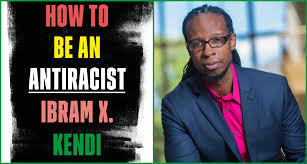
The Book Show #1664 - Ibram X. Kendi | WAMC

In Ibram X Kendi’s book “How to be an AntiRacist” he uses the example of Barack Obama, who rose to be one of the most powerful national leaders in the world. You cannot say he was powerless. While in that seat, he drove policies that increased racial inequities. He drove policies that cost lives, along racial lines. Obama appointed famously racist white policy makers into his administration where they developed and delivered abominably racist policies. One of them is quoted as saying:

“A given amount of health-impairing pollution should be done in the country with the lowest cost, which will be the country with the lowest wages. I think the economic logic behind dumping a load of toxic waste in the lowest-wage country is impeccable and we should face up to that.”

Lawrence Summers

There is also the case of Ken Blackwell, who, as a black secretary of state for Ohio, developed policies that deliberately suppressed black voters in order to favour George Bush’s 2004 presidential campaign – and Judge Clarence Thomas who doubled the number of dismissals of cases of racial discrimination within the Equal Employment Opportunity Commission. Professor of Black Studies Kehinde Andrews speaks at length about Candace Owens and her insidious anti-black rhetoric in support of US conservatism.

Kehinde Andrews speaking on Candace Owens and the issue of “The Psychosis of Whiteness”.

Want a more local example? Shane Jones, while in power, sought to establish policies that would directly undermine the inherited rights of Māori to their customary fisheries and protection of their marine estate – insulting their intelligence along the way. Winston Peters thought it funny to quip “two Wongs don’t make a white” in criticizing Asian land ownership in Aotearoa. The Māori Party sought to blame immigrants for the housing crisis during the 2020 electoral campaign in a way that placed refugee communities (already victims of global racism) directly, and unnecessarily, in the crosshairs.

Shane Jones gives Ngāti Whare $6m to grow millions of native trees |  Stuff.co.nz
Shane Jones targetted Māori fisheries estates and when they stood up to protect themselves, resorted to purile insults of their leaders.

Māori MP Paula Bennett, while in office as Minister for Social Development, drove policies that negatively targeted Māori and Pacific families while ignoring the same issues in pakeha families. She is Māori. She held power within this system. She used that power in a way that drove racial inequity. It’s simply not true to say that only white people can be racist. There are numerous Non-White MPs who have held office in this country – and while in office have driven policies that have perpetuated harm along racialized lines.

Next question is, can people of colour be racist towards white people?

Well, we have already established that non-white people can be racist towards each other – they can do this individually, and they can do this through policies and manipulation of the relative power that they hold. Racism can be delivered down, and it can be delivered across… can it be delivered up?

As Oluo notes, the first definition of racism (that it is any act of prejudice because of ones race) reduces discussions of racism down to a battle for the hearts and minds of individual racists, and misses the point that individual acts of racism are a part of a larger system. In short – if you only ever address it as individual acts, you will never overcome it, because you will fail to address the system that indoctrinates racists in the first place. We must address this at a systemic level.

So within that definition – no, racism cannot be delivered “up”. More often than not, anti-white statements are considered “racial prejudice” which are excusable by virtue of the fact that it lacks the systemic power to make it relevant or problematic.

There is a BUT, however, and here it is:

If you want to define racism through power analysis – you must also consider that racial prejudice against white folk reaffirms racial hierarchies and racist power systems. An anti-racist future is one where there IS NO racial hierarchy – not one where either 1) A racialised minority is at the top of the racial hierarchy or 2) A racialized minority is permitted to hit UP against whoever is at the top of the racial hierarchy.

Kendi puts it best:

“Anti-White racist ideas are usually a reflexive reaction to White racism. Anti-White racism is indeed the hate that hate produced, attractive to the victims of White racism. And yet racist power thrives on anti-White racist ideas—more hatred only makes their power greater. When Black people recoil from White racism and concentrate their hatred on everyday White people… they are not fighting racist power or racist policymakers. In losing focus on racist power, they fail to challenge anti-Black racist policies, which means those policies are more likely to flourish. Going after White people instead of racist power prolongs the policies harming Black life. In the end, anti-White racist ideas, in taking some or all of the focus off racist power, become anti-Black. In the end, hating White people becomes hating Black people.

Prof Ibram X. Kendi

You will notice, dear reader, that Professor Kendi does not at all shy away from the term “Anti-White racism”. He does not specify it as prejudice, he is focused more on the system that takes Black lives and forging ahead to an anti-racist future.

The pathway to this anti-future necessitates frank discussions about privilege, power, and fragility. It requires us to see racism as, in Kendi’s words, “a powerful collection of racist policies that lead to racial inequity and are substantiated by racist ideas.” So it requires us to deracialize our policies, and the minds that create those policies, through anti-racist action, thought, and education.

The suggestion that Māori are completely powerless, or that people of colour are completely powerless, stems from a racist idea (and in fact can be traced back to racist policies). It is not antiracist.

The suggestion that only White people can be racist, and that white people will only ever be racist within that system, erases all forms of allyship and condemns white minds to never being able to deracialize. It is not antiracist.

The suggestion that Māori can never be racist erases the harm that we can do with the limited access to power that we have in our own lands. It will never enable us to address how we have utilized relative power against each other, against wahine Maori, and against other marginalized groups. IMPORTANTLY – it will never enable us to explore how this behaviour supports a racially hierarchical system that we will never (and should never want to) reach the top of. It will inhibit us from bringing that racially hierarchical system down and growing an antiracist future for our children.

Too often, what’s been apparent in people tagging me into their online racism debates is that it appears to be about their own aversion to see themselves as capable of a racist act – because they, too, see racism as a permanent personal slur, a fixed characteristic (reserved only for whites) rather than an act that is informed by a system of racial hierarchy. They, too, are ironically focussed on themselves as an individual rather than focussing on the system.

I have said racist things, and thought racist thoughts… and it’s my ownership of that, my commitment to change, and my faith that the system can also change that makes me anti-racist.

Mauri ora.

T

Imperialism Must Die

Drawn by D. P. Dodd & others who were on the spot. Engraved by T. Cook 20 November 1784 Hawaiian Crowd numbers correct. Cook had grossly underestimated the Island population & the force of multitude aroused. Source: https://www.sbs.com.au/nitv/article/2019/02/14/how-foolish-rumour-hawaiians-ate-cook-began

Today, in Hawai’i in 1779, the imperialist known as James Cook was put to death. Across our moana, numerous communities celebrate this day, known in Hawai’i as Hauʻoli Lā Hoʻomake iā Kapena Kuke, (Happy Death of Captain Cook day). Of course much to the disdain of colonial descendants, who consider these celebrations macabre and, according to them, distasteful.

Before we go much further into this discussion, there are a few facts that bear remembering:

  1. Cook was a serial killer of Indigenous peoples. He murdered natives right throughout the Pacific: in Tahiti, in Tonga, in Aotearoa, in Australia, in Hawai’i. He would have continued to kill us had he been given further opportunity. How do we know this? Well accounts of the day before he was killed detail his orders and comments to his crew.

    Naval Lieutenant James King recounted Cook’s orders “that the behaviour of the Indians would at last oblige him to use force, for that they must not, he said, imagine they have gaind an advantage over us’.

Translation: Better a dead native than one who thinks above their station.

Think that was out of character for Cook? Nope – his journals are dotted with this sentiment – that regular shows of deadly force are necessary to remind natives of European supremacy. Ten years earlier, he had used this same justification for firing into a fishing vessel full of unarmed women, men and youth… killing all but the three young men whom he abducted. That evening he reflected in his journal:

“I am aware that the most humane men who have not experienced things of this nature will cencure my conduct in fireing upon the people in this boat, nor do I my self think that the reason I had for seizing upon her will att all justify me, but when we was once a long side of them we must either have stud to be knockd on the head or else retire and let them gone off in triumph and this last they would of course have attributed to their own bravery and our timourousness”

TRANSLATION Better a dead native than a native who thinks himself superior to us.

Throughout his three journeys were multiple instances where he took native lives for the mere reason of demonstrating white supremacy. He clearly felt that his duty to expand the British Empire included entitlement to take native lives. Cook did not invent that entitlement – it was in his orders, it was a part of his training (his naval mentor in his first overseas posting was Jeffery Amherst who was famed for purposeful infection of Mohawk communities through smallpox-laden blankets and was a self-confessed fan of the “Conquistador method” – hunting down and killing natives with dogs). In fact the very catalyst for Cook’s demise was the arrival of the news that his men on the other side of the bay had fired upon the locals, killing another Ali’i (just the latest in a string of deaths at the hands of Cook’s crew, and at Cook’s orders) – at the same time as Cook was attempting to abduct Ali’i Kalaniopu’u. The taking of native lives was expressly legitimised for imperial expansionists, dating all the way back to the 15th century where it was legally codified in the Doctrine of Discovery.

This, of course, is just the direct murders – they are in addition to the many more Indigenous lives lost through infection (both through handing out influenza-infected kerchiefs and through sexually transmitted diseases), through land theft or through injuries sustained through torture.

Which brings us to the second point: Now that we have established taking Indigenous lives was not a mishap but a form of modus operandi… now that we know it was an official and indoctrinated entitlement of his profession – we can reasonably deduce that he would have continued to take native lives in the pursuit of Imperial expansion – because our moana ancestors would most certainly have continued to resist his continued violations.

Simply put – Had Cook not been killed, he would have gone on to kill more of my ancestors.

And so today, we celebrate our ancestor’s resilience, we celebrate our survival, for in spite of all the efforts of the colonial imperial war machine WE ARE STILL HERE.

Indeed, in celebrating Imperial death – we celebrate LIFE.

We celebrate the halting of someone who had clear designs on Indigenous property and Indigenous bodies.

We celebrate all Indigenous women – we celebrate wahine Moana, like Kānekapōlei, wife of Kalaniopu’u, who had the foresight to warn her husband, and call her sons out of the vessel where they would have again been held captive like so many others abducted by Cook in his journeys. Because of Kānekapōlei, Kalaniopu’u survived, her sons survived. We celebrate the sacredness of Indigenous women and children who were all impacted, and are still impacted, by military imperialism and the sexual violence that comes with it – and colonial entitlement to our bodily territories, land territories and water territories.

We celebrate INDIGENOUS RESISTANCE in all its forms.

Plaque marking where Cook met Indigenous justice. Kealakekua Bay, Hawai’inui

We celebrate the overturning of white supremacy. Because in spite of Cook’s arrogance about his own superiority – he was ultimately met with Indigenous justice. This is an important reflection for us all today, fighting for our lands, our waters, our lives and that of our descendants at the hands of economic imperialists, who carry the same arrogant entitlement to the lands, waters and lives of others.

Today is a day for us to remember that Imperialism cannot be excused, cannot be legitimised, and cannot exist in the same space as human rights. Whether it be economic or military (or a combination of the two) – In order to honour life, Imperialism must die.

Like a Rat at the Nest: The Constant Defence Demanded of Indigenous Peoples

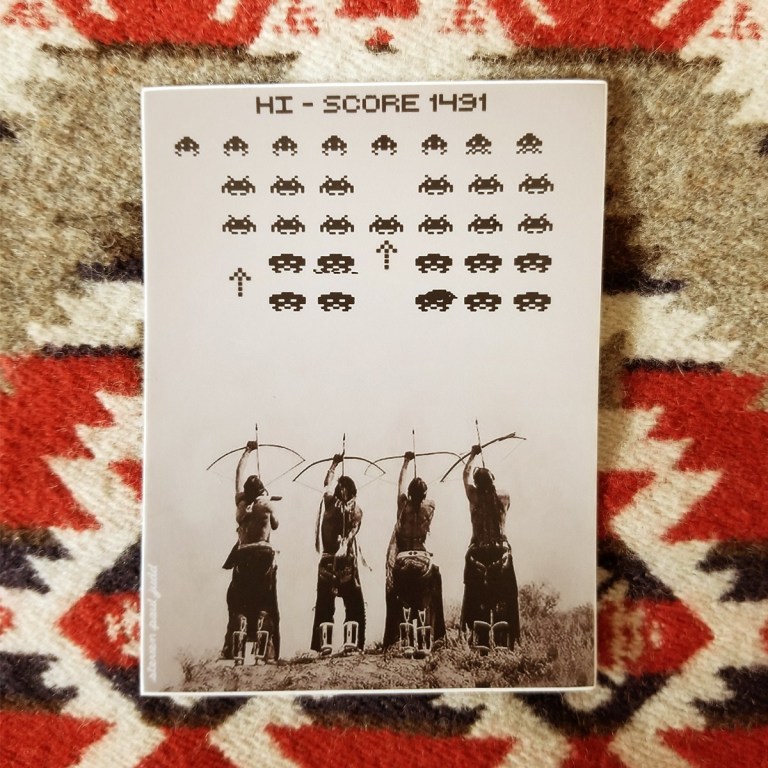
Space Invaders by Kiowa Chocktaw artist Steven Paul Judd.
Source: http://www.stevenpauljuddart.com/assets/39-spaceinvaders.jpg


There is an analogy I have often heard over the years of working with Indigenous brothers and sisters around the world in issues of conservation: The first and worst invasive species are the two legged sort. Like a rat at the nest of a native bird, the colonizer will come back at all hours, every day, constantly wearing you down until you give up and let it have its way.

For the non-Indigenous mind, reading this, I don’t think it’s easily understood just how very draining it is for us to protect our language, keep our whanau together, keep our children in our homes, keep our men and women out of the colonial injustice system, secure adequate healthcare, protect our customs, and always, always, protect our territories from the onslaught of colonial grabbery. Not only are new fires being set alight every day, but the fires we have put out keep coming back to life again, and again, and again, as well.

It steals time, heartbeats, and patience away from us. It steals the energy that we would otherwise be pouring into our own aspirations. The entitlement to the time and energy of Maori communities is staggering – with each group, person or organization thinking they are the exception, that it’s everyone else who is the problem but not them. Here is one example – just one, but a particularly potent example:

May be an image of 1 person
Wharekahika community coming together to hear the proposal in 2017. Image credit: Ani Pahuru-Huriwai

In our community of Wharekahika, the TerraFermah group have been trying to push through a logging port for four years. This comes after decades of other attempts to build a port, all of which have been opposed. Initially, when approaches were made to the local iwi in 2016, the iwi authority was warm to the idea of a feasibility study. Problem is… mana moana rests with the hapu. When the hapu called the iwi to meet with them in 2017 there were stern questions asked about why the concept was even being entertained without discussions with the hapu. After a long discussion where many of the local community expressed their continued opposition to the port, it was eventually agreed upon that a pre-feasibility study would be allowed, so that any opposition was made from an informed space.

Wharekahika local leadership, whanau, youth and kaumātua, again saying we do not want a port. Source: https://www.teaomaori.news/leave-your-ideas-north-hicks-bay-whanau-say-shane-jones

The next community meeting happened ten months later, the pre-feasibility report was shaping up and the port was looking a lot more expensive, with far greater ecological impacts than what had initially been proposed. The report proposed removing the seawall in order to cut costs, but this significantly increased the risk of an event where the vessels could crash and lose or discharge fuel into the bay and along the coastline. The feasibility report itself cost in the vicinity of three hundred thousand dollars, and included Cultural/geo-physical/logistics. It appeared that the Terrafermah group had, in addition to approaching the iwi, also approached Eastland Port and the sense from the community was that Terrafermah’s approach was becoming aggressive and predatory. Again the community came together to discuss the issue, air grievances and express their reservations, taking into account all of the research that had been done. A number pointed out that we are not anti-development but that a port simply does not fit with the community’s economic aspirations. Rail was one of the other infrastructural options put forward by the community for a feasibility report. The community response: too expensive both in terms of money and cost to the environment, and not a part of our own community aspirations.

Now keep in mind that every time a meeting is called, we need to call upon our elders, call families out of their homes and away from their own pursuits, we go through all of the protocols and expend mental and emotional energy dealing with what is being put before us – all the while aware that if we do not, the decisions are always made FOR us, and most often in ways that cause us harm. It’s an economic and regulatory system that has been developed to favour anyone with development agendas and ignore the rights of local hapu and the environment. Between each of these hui are also phone calls and smaller meetings so that the hapu can keep abreast of people who are insisting on developing plans for our property. All of this unresourced, all of it taking up time and energy of local people who are simply trying to preserve their own property for their own aspirations.

Our youth are very clear – their future does not feature a port. Source: http://www.gisborneherald.co.nz/local-news/20180827/hicks-bay-will-decide/

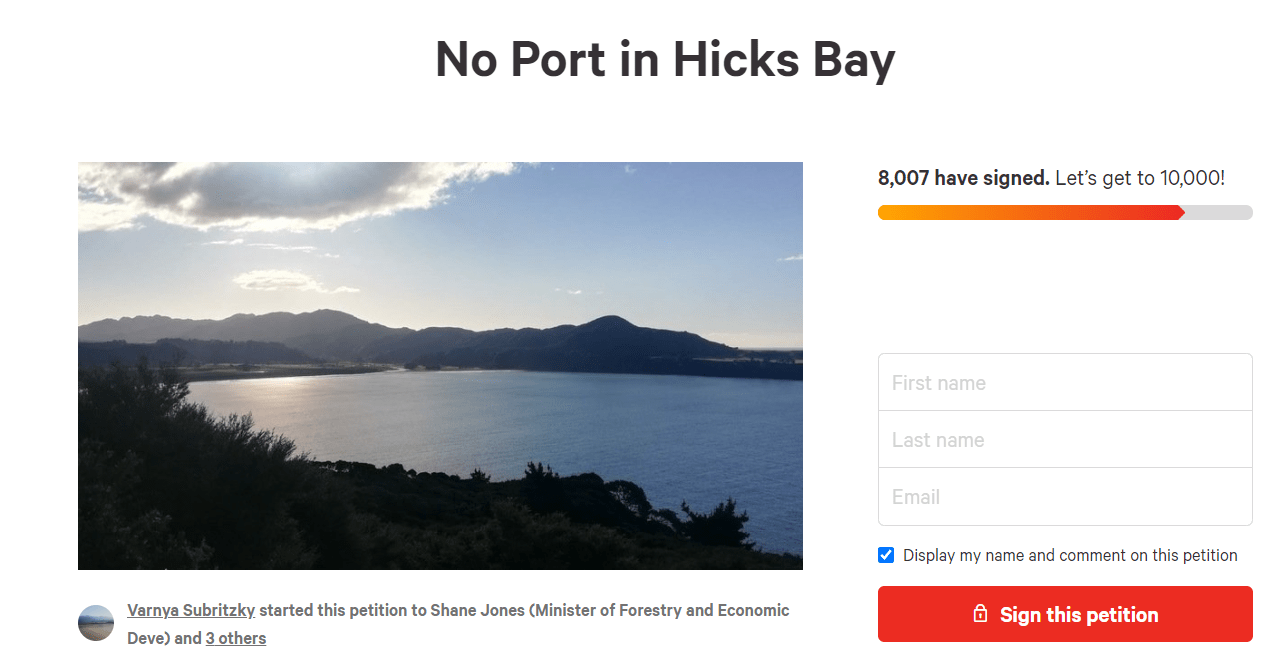
Ok so where are we up to – meeting number three, August 2018. Again, the community came out in force to engage in the discussion, with over 150 present. By this point, Rural Development Minister Shane Jones had been talking extensively in the media about his support for the port, and rather insultingly about hapu opposition. The pre-feasibility report that had been agreed to by the hapu was never provided TO hapu. It was again, however reiterated that without the hapū support, the port would not go ahead, and at this meeting, again, the sentiment was clear: No Port. Again, the whanau suggested that alternative measures such as rail be explored. In this meeting, as in the last, there were numerous concerns raised by both iwi and hapu about the practices of Dave Fermah and his business, TerraFermah, in how they were approaching this issue. Locals started a petition to demonstrate their opposition, which gathered over eight thousand signatures. Signs were erected around the township to make it clear that a port was not welcome.

Fourth hui, about a month later, the community again reconvened to discuss and vote on the matter. More tension. More emotional and intellectual energy. More debates. Still no pre-feasibility study had been presented, and again the hapu made their sentiments clear: No port, and no further support for a full feasibility study. In the words of Maori Committee Chair at the time, over the 11 years previous there had been at least 5 approaches to develop a port at that location, each time met with stern opposition from the community. Again, the community were at pains to make clear that we are not anti-development but that our own economic goals simply did not align with a port. The community outlined 13 reasons for their opposition which was communicated to the Iwi authority in detail, and at the time also pointed out that the process had been painfully time consuming for the local community. The pre-feasibility report was eventually provided, but it was nevertheless made clear that the issue, as far as the community was concerned, was closed.

Consultation document from 2019 again trying to re-engage over the zombie-port that just. won’t. die.

Again, in 2019 Shane Jones started up with media suggestions of a port at Wharekahika, at a similar time, Gisborne District Council started floating communications about a “blue highway” that would include a port at Wharekahika or Te Araroa. Cue meeting number five, with council and members of the local community who were rightfully outraged that 1. They were revisiting this issue and had evidently invested time and energy into the matter and 2. Were consulting broadly across the region for an issue that required hapu approval, and did not have it. Council staff were made aware in no uncertain terms that a port was NOT welcome in Wharekahika, that our economic aspirations were for non-extractive economies that invested in our people and a healthy environment, and to cease any further consultation with the broader region about a port in Wharekahika.

Undeterred, however, Terrafermah again returned in 2020 with further aggressive tactics. This time, Dave Fermah engaged a consultant named Tom Garlick to circulate letters around the community stating that he would donate money to the local schools and hospital, and that because he had addressed some of the reasons for opposition outlined in the letter of 2018 to our Iwi Authority, that the matter could now be re-approached. Not only had he done this, but he had gone to the extraordinary lengths of establishing a trust in the name of our community (The Matakaoa Community Trust) of which he was the sole trustee (living in Freemans Bay Auckland).

Cue community meeting number six, where the community sought confirmation from the schools and health board about their involvement with what we were now calling the zombie port. Both schools and the health board roundly rejected the offer of sponsorship, as it was clearly not in the interests of the community. In fact, at the time of sending the letters out, Dave Fermah had not even bothered with the consent of these groups for his proposed sponsorship. As if this was not distressing enough for the community – he went to the even more extraordinary lengths of establishing a website for the port that is riddled with assumptions, misdirection and straightup falsehoods.

A letter of complaint and continued opposition was registered with the Iwi Authority, who again reiterated their support of the hapu position against a port. Shane Jones, again, took the opportunity to attack the hapu through the media. His parting shot, before being ejected from parliament in the 2020 elections, was to allocate $45million towards the development of the port in literal spite of local opposition.

And now, in recent weeks, we have again heard that the port is being reconsidered, this time at the behest of Minister Grant Robertson’s office – who apparently don’t feel that the community have been clear enough in our opposition, and would like us to gather in yet another meeting to make our position clear. Six minuted meetings. Numerous media releases. A 8000 signature strong petition.

Of course, again – they have not yet come to the hapu, but rather have engaged with other groups in Gisborne (that being the Iwi and Council). The community is completely exasperated with the issue, we have met over, and over again. We have debated. We have seen the research. The process has been literally exhaustive, and the no is an informed no.

At this point – it is harassment. A colonial level of entitlement to people’s time and energy. It’s a troubling disregard for our non-consent,  and an assumption of supreme authority over our own territory, in addition to an abuse of Crown privilege and resources. We are not resourced, and have not been resourced, to continue to meet, and debate, and oppose this issue. We are not resourced to write to media, and the Iwi, and the council, and whoever else government sends to us. We are trying to pursue our own economic aspirations as a community, but between this, and all of the other frontlines we are expected to engage upon, we are exhausted. And this, this is the reality of living as Indigenous peoples in colonized times – just the act of living uninterrupted in our territories requires INORDINATE amounts of reactive energy. Energy we would rather be putting towards our children, our families, our own dreams and other pressing issues like climate resilience and the restoration of our coastal fisheries and forests that have already been depleted by the Crown.

So here we are again, saying NO to a port. Invest in exploring rail. Invest in non-extractive economies. And for Treaty’s sake – respect our NO when we say it.

Sexual Violence and The Doctrine of Discovery

CONTENT WARNING: Sexual violence and rape of women, youth and children.

This piece was written after a late night chatting with my dear relation Mereana Pitman who has been working in the prevention of family violence and sexual violence for over 40 years, and about the same period of time campaigning for, and educating on, Treaty justice. These are our combined reflections upon the role of the Doctrine of Discovery and sexual violence.

It is, perhaps, a mark of the year that 2020 has been that the creation of a new ministerial portfolio for the prevention of family and sexual violence sailed past the bluffs of the election media without barely a mention.  Aotearoa has some of the highest rates of family and sexual violence, and it is a cornerstone issue – it impacts upon multiple other spaces of mental health, the rights of women, youth and children, crime and incarceration to name just a few. It is a cornerstone issue in the social ecology – and while its impacts upon Māori communities are distinct it should not be understood as a Māori problem. It is, in no small measure, a colonization problem, and like all stories of colonization it requires a thorough understanding of the history of sexual violence in a colonial context. Here are just a few important considerations for us to keep in mind in considering the role of sexual violence within a colonial state:

América: James van der Straet
The Discovery of America, Jan van der Straet, 1575

Sexual violence is a tool of conquest and colonization.

We should, first, understand sexual violence as a primal act of domination that features across species, and certainly across cultures. It is used to punish, humiliate and destroy, and has been used as a tool of war, conquest and domination for as long as war, conquest and domination has existed. We then, must understand imperial expansion as acts of war, domination and conquest, and colonialism as the maintenance of domination. For nations that have undergone colonisation, sexual violence is one of the many tools that has been used to establish and maintain domination – and it has been an extremely effective one.

The Doctrine of (Christian) Discovery is an international legal and social concept which created sets of entitlements for European monarchs to expand their empires throughout the world. In the words of the papal laws, these entitlements included the right to:

invade, search out, capture, and subjugate the Saracens [Muslim] and pagans [Non-christians] and any other unbelievers and enemies of Christ wherever they may be, as well as their kingdoms, duchies, counties, principalities, and other property […] and to reduce their persons into perpetual servitude.

Dum Diversas

It’s important to note that even though these laws are ostensibly about the right to claim land, the first rights accorded are the rights to “invade, search out, capture and subjugate” Saracen and pagan people, followed by the right to then take their property, including their lands. This comes as no surprise within the context that these earliest of papal bulls were primarily aimed at establishing a slave trade.

However, within a very short period subsequent papal laws then expanded the entitlements both in scope of the geography (moving from the right to invade and claim West Africa, to the right to invade and claim the “New World”) and in provisions (increasing, and clarifying, what could be taken and done).

Under the likes of Christopher Columbus and Francisco Pizarro, the application of the Doctrine of Discovery utilised sexual violence from the very outset. One of the documents utilised in the process of applying the Doctrine of Discovery was called El Requierimiento. It was read out as a proclamation of discovery to the natives of the lands being claimed (of course it was never understood, and was in many cases read as a formality upon sighting the land, just before invading it and waging war upon the natives of that land). It reads as follows (emphasis added):

“… We shall powerfully enter into your country, and shall make war against you in all ways and manners that we can, and shall subject you to the yoke and obedience of the Church and of their Highnesses; we shall take you and your wives and your children, and shall make slaves of them, and as such shall sell and dispose of them as their Highnesses may command; and we shall take away your goods, and shall do you all the mischief and damage that we can, as to vassals who do not obey, and refuse to receive their lord, and resist and contradict him; and we protest that the deaths and losses which shall accrue from this are your fault, and not that of their Highnesses, or ours, nor of these cavaliers who come with us.”

El Requierimiento

Here we see, in the tools of the Doctrine, the explicit entitlement towards women and children, the intention to make war in all ways possible, to “do all the mischief and damage that we can”, and importantly, that all blame for this will be upon the victims themselves. Unsurprisingly, the mischief described consistently involved sexual assault. Franciscan monk Bartolome De Las Casas recorded the events in his journal regarding Columbus’s invasion of Haiti:

“This was the first land in the New World to be destroyed and depopulated by the Christians, and here they began their subjection of the women and children, taking them away from the Indians to use them and ill use them…. And some of the Indians concealed their foods while others concealed their wives and children and still others fled to the mountains to avoid the terrible transactions of the Christians… They behaved with such temerity and shamelessness that the most powerful ruler of the islands had to see his own wife raped by a Christian officer.”

De Las Casas

Bartolomé de las Casas y su Brevísima Relación de las Destrucción de las  Indias | Ruma de papeles

Further accounts are provided by crew members of the orders given to rape women, and in the instances of crew such as Miguel Cuneo, where native women were “gifted” by Columbus and subsequently raped. Sexual trafficking and sexual violence against women, children and youth featured throughout what became known as the “Age of Discovery” (better termed the Age of Genocide). It featured in the voyages of Magellan, of Pizarro (and indeed all conquistadors), and of James Cook.

A chilling but important blog piece on colonial rape as a tool of colonial conquest. (TW)

In the case of the British colonization of India, not only was the colonial rape of Indian women widespread, but colonial laws were adopted which placed a heavy standard of evidence upon rape victims only for cases where the accused was a British officer.

AND SO – The history of colonization must include the employment of sexual violence and trafficking as a tool of domination and conquest, and conversely the history of sexual violence must include its specific use against Indigenous peoples as a part of the colonial project.

Sexual violence is intended to strip the sacred

Sexual violence is a form of consumption, and so, in consuming you, it attempts to desanctify you, making you not only property, but consumed, defiled and defecated property. In making you non-sacred this legitimizes the entitlement to take whatever is required of you, because you do not matter. It is the most powerful expression of you not mattering, along with extinguishing your life.

The whare tangata (womb) is seen as a sacred repository for Hine, in the form of Hineteiwaiwa, who oversees the female reproductive cycles. It is the space where the divine and human come together. It is a portal for souls to enter this world. The assault upon this aspect of our sacredness is one intended against not only the victim, but the line which continues through her. Sexual violation and commodification of Indigenous women is also associated to their hypersexualisation and subsequent cultural appropriation. The “Dusky Pacific Maiden”, and “Squaw” tropes are two examples of of how the Indigenous feminine is hypersexualised, commodified and consumed for colonial entertainment, through literature, through porn, and through costumes. Today, still, the true story of Pocahontas which obscures and erases colonial rape is made all the worse by the continued commodification and hypersexualising of her story and image, primarily through the likes of Disney, which then drives subsequent hypersexualised costuming every single Halloween.

Does Disney's Pocahontas Do More Harm Than Good? - The Atlantic
Pocahontas

Furthermore, the rape of children in particular is a stripping of sacred innocence that feeds a colonial compulsion to acquire all that can possibly be acquired of a people. Nowhere is sacred when even the innocence of children can be taken. As we have seen in the cases of children taken and then abused through the state system both in Aotearoa, in Australia and on Great Turtle Island, the deep, psychological and spiritual damage that is done through sexual violence passes on intergenerationally, and after the first instance, the colonial perpetrator becomes the Indigenous vector.

AND SO – healing sexual violence necessitates spiritual healing.

Sexual violence is synonymous with environmental violence.

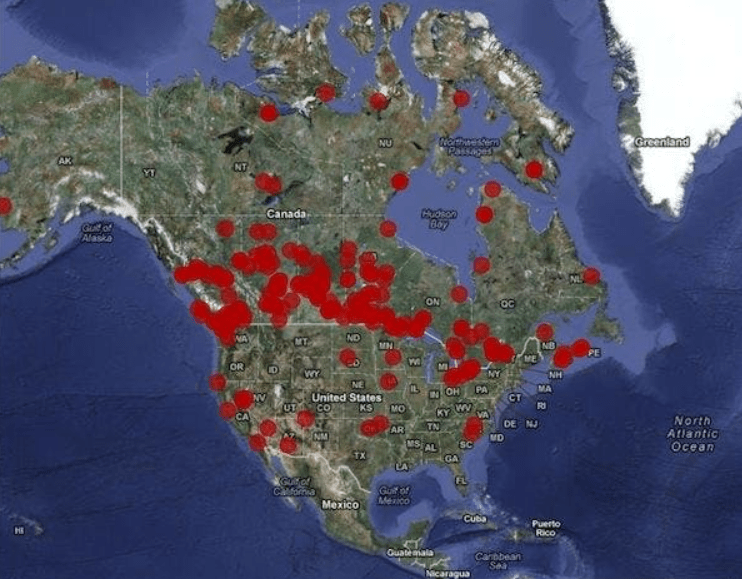
As outline above, sexual violence is a powerful tool to facilitate the taking of land. Making you insignificant is an important step in the legitimizing of the theft and abuse of your land and waters. In particular, the aforementioned assault upon the womb is one which, with its many associations to sacred land and waters, extends to the entitlement to own, and abuse, the natural Indigenous world. This is not only historical but also contemporary, and is further evidenced in the correlation between oil pipelines and missing and murdered Indigenous women on Great Turtle Island (insert maps).

As pointed out by Dr. Dawn Memee Harvard, Native Women’s Association of Canada in her United Nations submission:

A 2014 report by the ILO estimated that 21 million individuals are being trafficked for sex or labor globally per year and showed that sexual violence and trafficking is exponentially higher near points of extraction and worker camps, or “man camps” than it is in locales of similar population.    Destructive, resource-intensive, and often forced practices of mineral extraction are primary ways that colonialist conquest and genocide continue today, through simultaneous violence against the land and against indigenous peoples, disproportionately affecting women and girls.  

Dr. Dawn Memee Harvard

Indeed, at Standing Rock, at the Alberta Tar Sands, in Peru, parts of Africa and around the world, environmental exploitation is synonymous with gender based violence. In all of these places, historically and in a contemporary sense, Indigenous peoples are subjected to sexual and gender based violence as a response to their efforts to return and protect their Indigenous territories.

Map of major oil pipelines in the USA/Canada
Map of Missing and Murdered Indigenous Women in USA/Canada

AND SO – sexual violence and gender based violence must be further understood as a precursor and facilitator of environmental harm that disproportionately impacts Indigenous peoples. Environmental colonialism must also be understood as an issue which increases the likelihood of sexual and gender based violence against Indigenous communities.

Sexual violence dispossesses/displaces us of our bodily, emotional, spiritual territories.

It is a commonly seen consequence of sexual violence that survivors disconnect themselves from their bodies/emotions/spiritual selves in order to survive. This displacement can remain lifelong, and can then lead to behaviour that is symptomatic of the heart, mind, soul, body and collective being displaced from each other. This is particularly true of children who are nowhere near equipped to be able to deal with the trauma of sexual violence.

Their pathological selves are disconnected from community, through the shame associated with sexual trauma. The shame of being defiled. The shame of sexual dysfunction. All of these things drive victims of intergenerational sexual trauma away from the community. In some cases, the community finds it easier to ignore what is happening, or attack the victim, than deal with the sexual violence itself, and in other cases it is the victim who perceives the shame and never raises it to the community.

Hurt people hurt people. Our patriarchal, heteronormative, Christian society does not allow for deep discourse on sexuality. Where all sex is seen as a sin, open intergenerational discussions about sex are limited and consequently our ability to differentiate between natural, healthy sex and sexual violence is also limited. It vilifies the intergenerational vectors of sexual violence, forcing them underground, away from healing, so that the harm continues in our communities. The depth and scale of trauma created by sexual violence, coupled with the lack of effective support, underpins the “state-care” to prison pipeline and is consequently linked to a wide range of harmful outcomes for individuals, whanau and communities.

AND SO – healing sexual trauma in Maori communities necessitates processes that reconnect us to our physical, emotional, spiritual and communal selves. It needs to be connected to our work on suicide and addiction, and understood as a major contributor to hyper-incarceration. It further requires a range of healing approaches both for victims and vectors of intergenerational sexual trauma, as well as their communities.

Sexual violence has promulgated through Maori communities at the hands of the Crown.

There are two significant sites of our colonial history that have contributed to sexual assault within Māori communities: warfare and “state care“. Over 100,000 children were placed into state care in just 40 years, with the rate of Māori being between 50% and 90% depending on the year, and the region. Abuse in state care is rife, and reports indicate the the vast majority of that abuse that has occurred also happens to Māori.

In consideration of these numbers, one simply cannot overstate the impact of what we can safely term the mass-rape of Māori children by the state. Moana Jackson says “you cannot take a young man in a prison cell and look at him separately from the experience of colonization”. The same can be said of sexual trauma in Māori communities. We simply cannot look at it in isolation of the experience of colonization and the utilization of sexual assault as a tool of colonization both to us, and through us.

Militarism and sexual assault goes hand in hand. It is a part of the oldest military strategies. If we understand the “Age of Discovery” as a series of war crimes, invasions of Indigenous nations – then we can see that the same tactics were employed as military strategies. It occurred in Africa under Dum Diversas. It occurred in Haiti under Columbus. It occurred in Aotearoa at the hands of Cook’s crew. It occurred in Aotearoa as a tool of the land wars, at Rangiaowhia, at Parihaka, at Maungapōhatu. Our tipuna were further exposed to wartime sexual violence in the battlefields of Europe and North Africa during World War 2, and in Vietnam. It occurs, still in Afghanistan. Sexual violence has occurred, and continues to occur, throughout the Pacific in and around the military bases. Sexual trafficking, forced prostitution, sexual assaults, all spike around military bases. Essentially, where there is war, there is sexual violence.

Our tipuna came back from war broken, and hurt men. Men who had been exposed to wartime sexual violence. Men who were offered little more than alcohol or drugs to numb the trauma of what they experienced. Addicted, traumatized, hurt, and then planted back into our communities where the hurt became intergenerational.

AND SO – sexual assault within Māori communities must be understood as a legacy of colonization.

Colonial Sexual Trauma is Capitalised Upon by the Colonialism Industrial Complex
Just as there is a poverty industrial complex and a nonprofit industrial complex – colonialism also exists, itself, as an industrial complex. Many billions of dollars is spent on the social fallout of sexual trauma, through Corrections, through counselling services, through social service providers, through Oranga Tamariki, through women’s refuge…. and the vast majority of the funding either cycles back through the State, or is paid out to pākeha social service providers. Numerous studies and experts have concluded that the subsequent services are not geared for Māori, and fail to provide the appropriate healing required for spiritual, physical, emotional, and communal wellness.

One doesn’t have to impugn the motives of the individuals and nonprofits working in this industry to observe that, in the aggregate, they consistently behave like other industries: working closely with elected officials and government agencies to preserve the government funding that supports their work. The result is ingrained inertia that makes it harder to shift resources to programs that could provide better outcomes and do so more efficiently.

Daniel Stid, Washington Post

When you look at how the complex is facilitated, through relationships of privilege and social opportunities that are built out of a background of education and qualifications that are also acquired through socio-economic privilege, it is easy to see how easily pākeha turn a profit from the colonial harm visited upon Māori. This is not uncommon within the framework of the Doctrine of Discovery, where the extraction from Indigenous peoples and their territories underwrites the global imperial economic complex.

AND SO – Dismantling the Doctrine of Discovery within the sexual violence-social work sector means primarily resourcing Māori services to provide multi-level healing services from the colonial legacy of sexual violence.