



Discussions for whānau, hapū, marae, and kura
Covid is on the way. Our vaccination rates aren’t yet what they need to be, and while quite a few communities (like ours) are pulling out all stops to do what we can to raise the vaccination rates, in the meantime, there are some urgent discussions and plans that we need to carry out, at a community level.
WARNING: These are taumaha (heavy) discussions. They are not pleasant, and for some they might be fearful, but they are important, and for many others, they are discussions that bring some level of comfort because they enable us to prepare.
I’ve been getting a lot of requests from different sectors asking me what we should be considering, and it appears there is little guidance out there. Just to remind people: I’M NOT A COVID EXPERT. But I am a researcher, and have a valued network of qualified, independent experts who I trust. We are holding some of these discussions at a community level right now, and so I’m going to share with you what some of these discussions look like.
I’m going to mention the word vaccinate often. That’s because the absolute best prevention measure is to vaccinate. The proof of that is quite simple: it’s in the percentage of positive cases that are unvaccinated:


The most heartbreaking of those lines, for me, is the Under 12 line who did not have a choice whether to vaccinate or not. Every time somebody says it’s about personal choice, I think about them.
These considerations are in three sections: Whānau planning; Hapū planning; and Kura planning
WHĀNAU PLANNING
- Vaccinate.
- If you have children in your household that are too young to vaccinate, or whanau who are not able to vaccinate for medical reasons, then consider how you need to protect them. You might want to consider letting people around you know that you have people in your household who do not have the choice to vaccinate, and because the best way to protect them is to ensure everyone AROUND them is vaccinated, then you are only accepting vaccinated visitors.

3. Plan for covid care. If you have unvaccinated whānau in your household, or in the rare instance of a “breakthrough” infection, it is likely you will have to isolate at home. You should have a plan ready that can be actioned as soon as one of you tests positive. You should be ready to isolate immediately, ideally have the positive person isolate from the rest of the household, the rest of the household will need to be tested. If you are lucky enough to have not had it transmitted inside your household, then you can prevent it by having ONE person only tend to the covid patient’s needs.
You might want to consider the following:
- What kind of care does a covid patient require?
- consider addiction needs, appropriate dietary needs, hydration needs, countertop medicine that can help to relieve some of the symptoms like fever
- Do you have a space where they can safely isolate at home away from the rest of the household?
- What childcare arrangements will you need to make if you are a primary parent and fall ill with covid?
- Do we have reliable access to clean drinking water?
- Is your home/the isolation space well ventilated, dry, warm?
- Ventilation is important – it is better to have a ventilated room with blankets and warm clothes than an unventilated room.
- Try to keep your surroundings to a standard that would help anyone get better from the flu (ie minimise condensation, damp and mould).
- Consider investing in an air purifier with a HEPA filter. These can be expensive…. if you are on a benefit then you might want to consider talking with your doctor about a referral for your case manager. Especially if you have unvaccinated children or are on a health and disability benefit. Consider contacting a benefit advisory/advocacy service like BAIS who can advocate on your behalf or advise you on accessing these.
- If you cannot source a purifer for whatever reason, then keeping the room ventilated with fresh air can also be achieved by having a window open, with a fan facing the window.
- Do you have reliable access to a support person if you urgently need something purchased and delivered?
- Consider investing in an oximeter – they can help you to measure oxygen levels and pulse rate to monitor your patient (in some cases you may be able to access one through your DHB. If you are on a benefit then speak to your case manager about purchasing one as a health requirement).


- Here is a link to the NZ resuscitation council guidelines on covid and resuscitation.
- Do you have an advance care plan organized so people are clear about your wishes for health care, resuscitation and other decisions if you are unable to communicate? Here is a link to the Health Quality & Safety Commission NZ guide for advance care planning.
- Here is a link to the live document developed by @jenene (Jenene Crossan) which outlines helpful equipment to have at home while healing from covid. (NB it is NOT medical advice it is a list of equipment that covid patients have self-reported as helpful/necessary while they were recovering . PLEASE check with a clinical specialist)
4. If a member of your whānau/household is:
– A minitā/tohunga
– A pou kōrero/pou karanga
– Undertaker
– In a role to do with caring for tūpāpaku or supporting grieving whānau
How might you support them for the increased level of work that may be ahead of them? People in these positions often have a “N-yes” challenge (they wind up saying yes even when they want to say no). Can you nominate someone to monitor the demands on their time and energy, and step in when necessary? Do they need a checklist of covid-safety requirements to keep themselves safe in carrying out their duties? What are the safety precautions they need to take when coming home from their mahi, in order to keep the household safe? Can anyone else be trained to share the load?
Here is another wonderful resource to help you consider what you need to do as a whānau to be prepared:


HAPŪ PLANNING
- Vaccinate

- Vaccinations and quality information are vital tools in combatting covid at a community level, but the best strategy is a “whole of cake” strategy…. the safest community is a community that is well informed, well vaccinated, and well masked. None of these tools are as effective as all of these tools together. (Note contact tracing may be getting phased out as the positive case numbers get out of hand, but it’s still a good idea to ask people locally if they have been to a location or region of interest).
- How will you deal with the pouri of mass loss in your community? What are the provisions available to you to deal with whānau in distress, or indeed numerous whānau in distress, or an entire community in distress over a sustained period? Do you have access to quality kaiawhina in this area? What role could pure, karakia, waiata, māramataka, kōrero pūrākau play in the healing of the mamae ahead?
- What are your plans for your marae? Will you stay closed? Will you have conditions for how to operate when open?
Rapid antigen and saliva tests are popular covid suppression tools overseas with some restaurants having rapid antigen test rest areas outside of venues and restaurants and customers arriving 20mins early to get tested before they can go inside. Many households overseas have now normalised testing and test themselves at home a couple of times a week. Rapid antigen tests are now approved for use in Aotearoa. Is a rapid antigen test area something your marae may want to consider? (note: Rapid Antigen Tests help with suppression, they are not 100% effective because they do not pick up low levels of the virus. While they are convenient and accessible, they should be used in combination with masks, distancing and other rules like telling people to stay home if they are sick).


3. Urupā and tangihanga planning.
Pray for the best, but be prepared for the worst.
– Do you have a plan for high mortality rates?
– Here are the MoH guidelines for dealing with tūpāpāku and funeral services
– How might you support social distancing at tangihanga?
– Do you have supplies of masks and contact tracing resources?
– What is your urupā capacity? How might you be able to cope with an increased mortality rate?
– How can you manaaki/tiaki your pou kōrero, pou karanga, and others involved in the care of tūpākaku and whānau pani?
– How will you handle hākari? Should hākari meals be offered in takeaway containers? Should hākari be cancelled? If you have hākari on your marae, what are the ventilation and covid requirements?
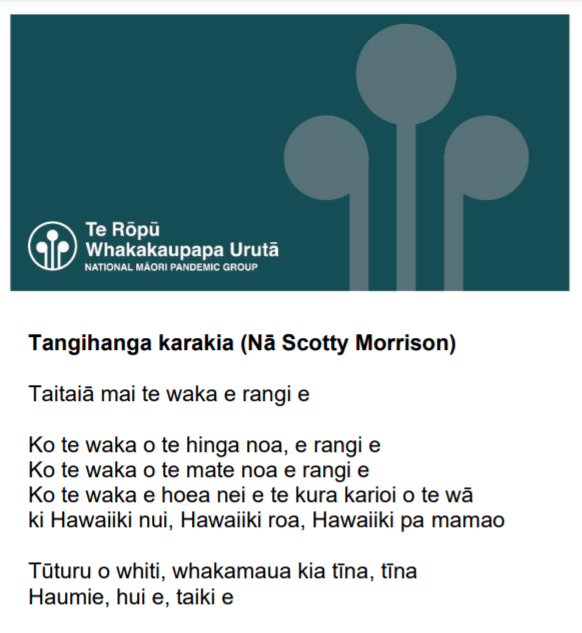
4. Communications strategy
Good public health information is a crucial factor in community health. How will you communicate vital information out to your hapū? Via social media? Do you have someone who can print information out and leave in letterboxes/Po boxes for whānau who are not on social media?
Who are your trusted sources of information?
Here are some excellent links for relevant, reliable covid advice:
Te Roopu Whakakaupapa Urutā – The National Māori Pandemic Group has excellent resources and advice on a wide range of covid issues, made relevant to Māori.
Protect Our Whakapapa – Simple, powerful, on point resources for whānau to protect our whakapapa from covid.
Dr Rawiri Taonui consistently and tirelessly analyses covid for Te Ao Māori
Dr Morgan Edwards has an easy-to-follow, comprehensive instagram page with quality covid information


KURA PLANNING
- Vaccinate
- The government has mandated vaccination for all school staff (teaching and non-teaching). While that reduces the risk, it does not eliminate it. Every kaiako and staff member at our kura is vaccinated, but we are keeping our taonga home because we do not know if all of the households of other students (especially U12) are vaccinated. While we know that young children often recover well, those have have required hospitalisation, have suffered long covid or severe covid have been children with underlying health problems, in particular underlying respiratory healthy problems. Overarchingly in Aotearoa, that will be Māori and Pasifika children. Here is a very good general article by the incomparable Dr Jin Russell who outlines a gold standard plan for safely reopening
- What provisions will the kura have for parents who need to keep their children home for safety reasons, until they are vaccinated?
- How will the kura protect young children from unvaccinated parents who may be dropping off or picking up children?
- Soon the Pfizer vaccine might be available for 5-11yr olds. Should the kura be considering (if it hasn’t already) kura vaccine clinics so the vaccine is readily available to students and their whānau? Do the whānau need a wānanga on vaccines first, with some trusted information sources?
- How will you, as a kura, work to protect our pēpi under 5?
*Important info for parents of under 5: For newborns best protection comes by mother being vaccinated in pregnancy, breastmilk tops up protection and the natural sugars in milk help baby to develop a strong immune system through gut bacteria. Vaccination in pregnancy protects mother during pregnancy and postpartum when she is at high risk from COVID-19. For older infants, mother’s being vaccinated while breastfeeding is likely to have some benefits to reduce risk of transmission and some antibody transfer, but only temporarily (some studies suggest 4 weeks). For toddlers, their own immune system is more developed than infants and are currently less likely to get sick from COVID. For all babies, their best protection comes from everyone around them being vaccinated and staying away when sick.
Other studies on vaccinations for pregnant and lactating Māmās:
https://jamanetwork.com/journals/jama/fullarticle/2780202
https://www.medrxiv.org/content/10.1101/2021.03.06.21252603v1
- Will classrooms be well ventilated? Here is an excellent article on the importance of ventilation for classrooms. Here is another link to a study carried out by Otago University that outlines the importance of ventilation, HEPA air filters, and CO2 monitors for classrooms.
- What education resources are available for your kura on covid, vaccines, and misinformation?
As more resources or important considerations come to hand, I will add them up here. Again, these aren’t easy discussions, but they are important. It is equally important that you hold these kōrero with aroha, couched in karakia, and to consider the important processes of pure and tuku in order to release the weight of the discussion afterwards.
Indeed, reading this blog may leave you feeling taumaha. I invite you to tuku. Turn off the device, sit quietly for a moment with the weight of what you have read. Acknowledge it. Commit to taking an action (it might be discussion with your GP, it might be creating a resource, it might be a phonecall to learn about services, it might be doing more research, it might be calling a hui) in relation to it. Bless the weight, and release it to the universe, while retaining your commitment to action. Remember, we have come through this before as a people, and while it’s important to prepare, it’s also important, and possible, to both prepare while holding hope and faith. Offer a brief karakia to emerge back into Te Ao Marama.
Unuhia, unuhia, unuhia
Unuhia ki te uru tapu nui
Kia wātea, kia māmā, te ngākau, te tinana, te wairua i te ara takatā
Koia rā e Rongo, whakairia ake ki runga, kia tina, tina.
Hui e, taiki e.

